
Most food businesses know their menu prices but not what each plate really costs. Supplier prices move every few weeks, trim and waste go unrecorded, and a dish that was profitable last year quietly is not any more.
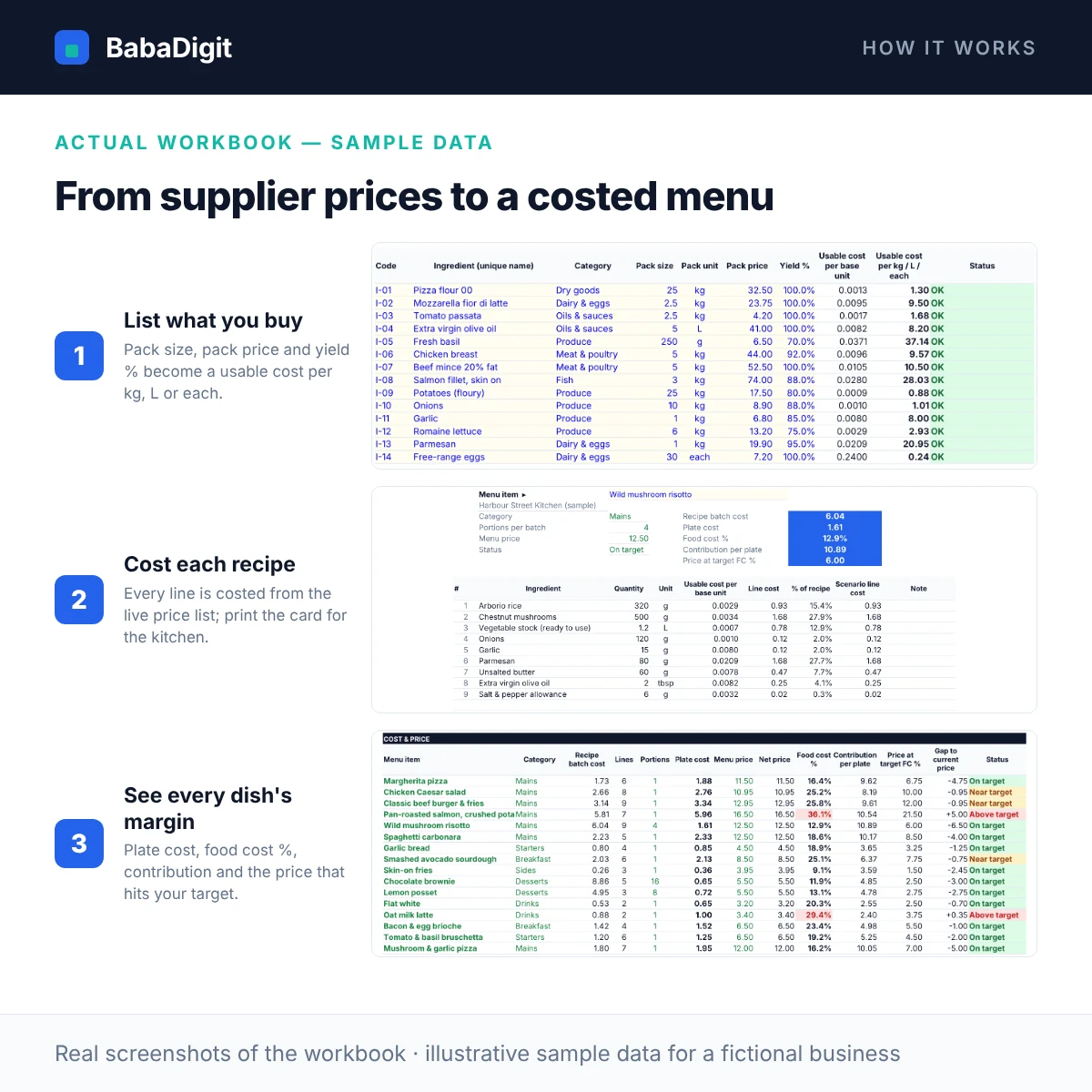
This template keeps one price list for everything you buy. Enter each ingredient’s pack size, pack unit and pack price, plus a yield % for trimming and waste, and it works out the usable cost per gram, millilitre or item. Recipe lines then cost every dish from that live list — in g, kg, oz, lb, ml, L, tsp, tbsp, cup, each or dozen — so one price change flows through every dish that uses the ingredient.
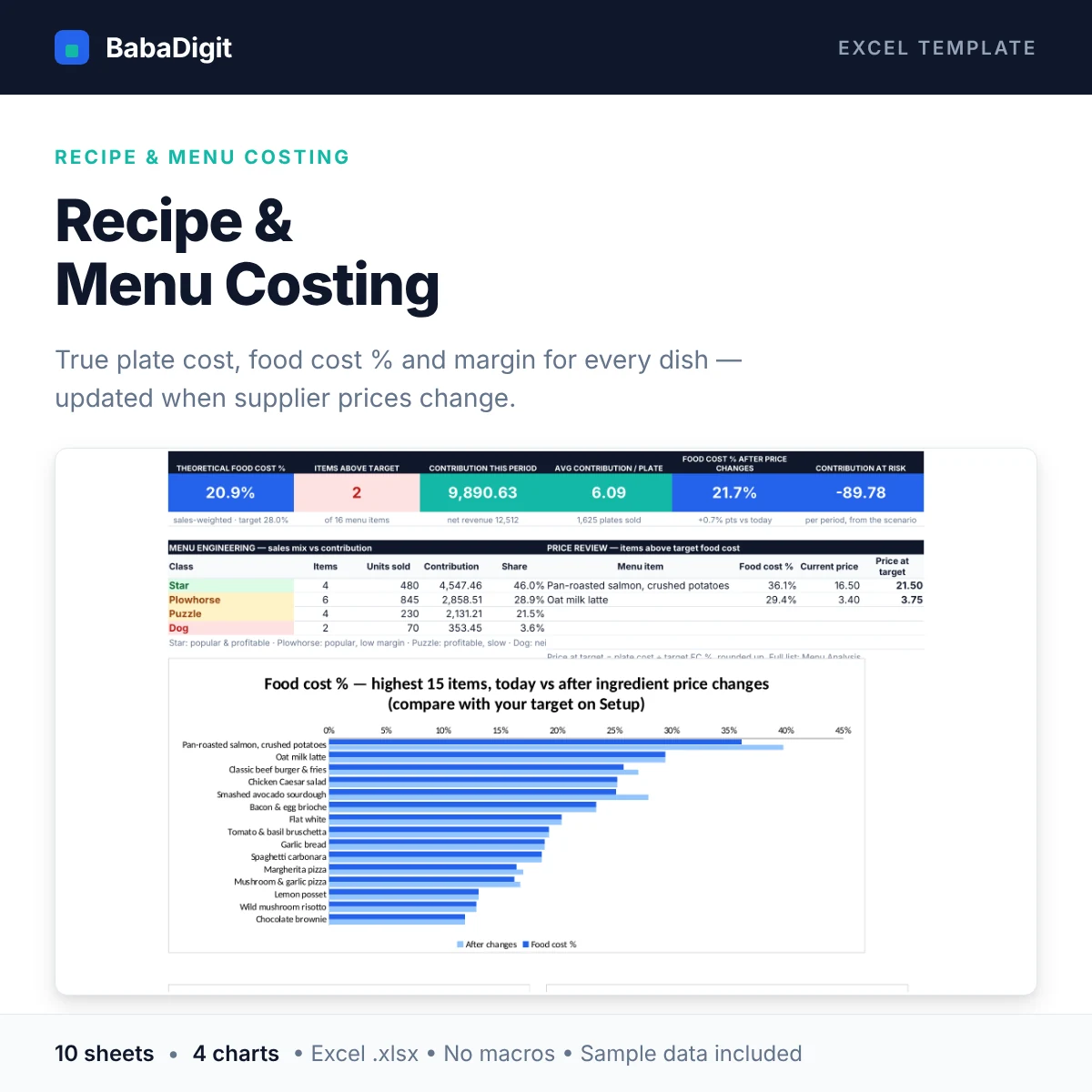
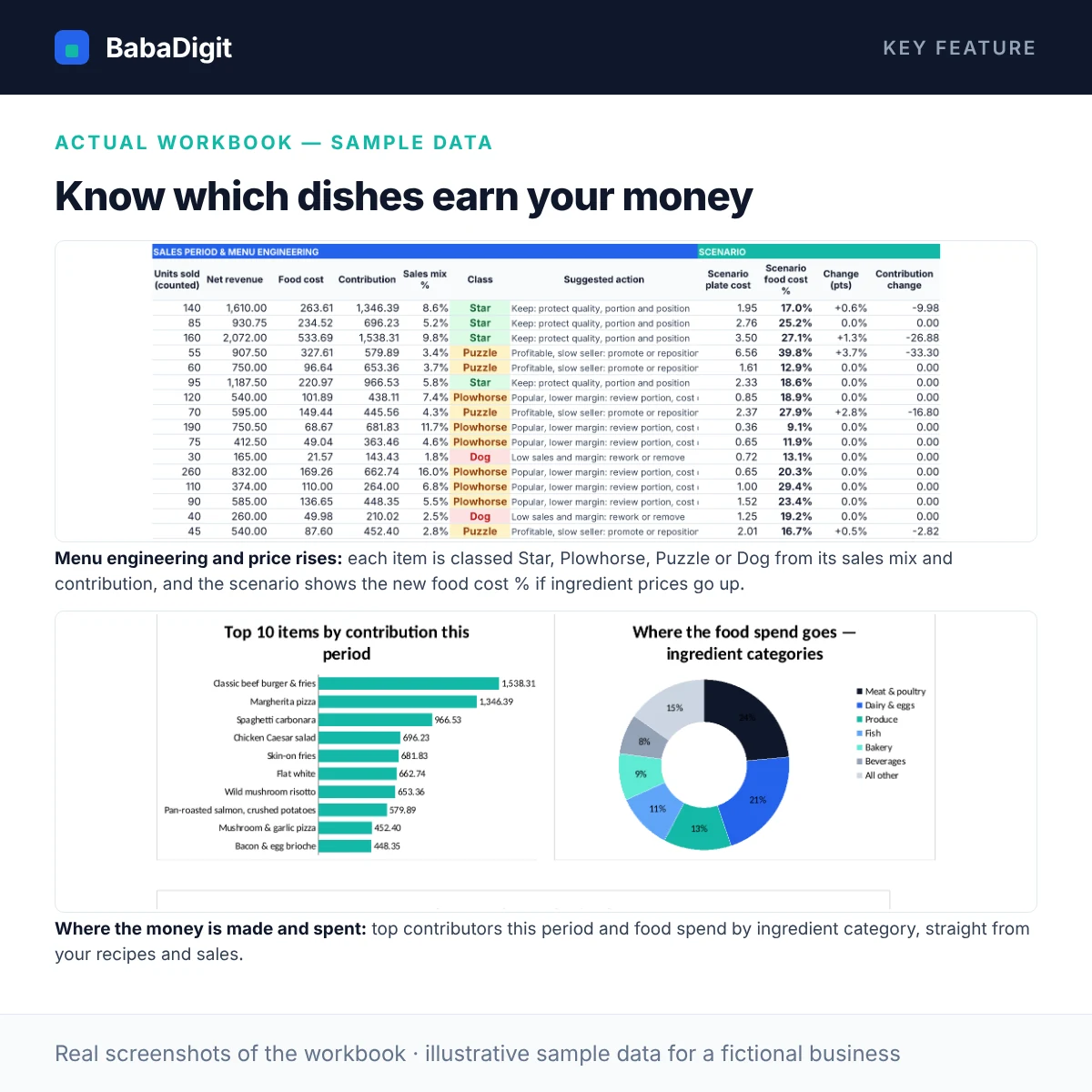
Menu Analysis shows plate cost, food cost %, contribution per plate and the price that would hit your target food cost % for every item. With units sold for a week or a month, it adds period revenue, food cost and contribution, classifies each item as a Star, Plowhorse, Puzzle or Dog, and shows what a set of ingredient price rises would do to your food cost % and contribution.
What you get
- Ingredient price list for up to 200 items with yield %, unit conversion and usable cost per kg, L or each
- Up to 800 recipe lines for up to 60 menu items, including batch recipes (e.g. a tray of 16 brownies)
- Plate cost, food cost %, contribution per plate and status (above / near / on target) for every item
- Price at your target food cost %, rounded up to your chosen step, with tax/VAT-inclusive pricing supported
- Menu engineering: Star, Plowhorse, Puzzle and Dog from your sales mix and contribution, with a suggested action
- Price-rise scenario: an across-the-board % plus a % per ingredient, showing new food cost % and contribution at risk
- Dashboard with six KPIs, a price-review list and four charts: food cost % by item, top contributors, food spend by ingredient category, and revenue vs food cost by menu category
- Printable recipe card for any dish, with line costs and % of recipe cost
- 11 built-in checks (unit mismatches, missing prices, duplicates, two reconciliations) with an overall status
- Macro-free .xlsx with protected formulas and clearly marked input cells
Sheets in the workbook
- Start Here — Purpose, quick start, a live worked example, colour key and navigation.
- Dashboard — Food cost %, contribution, menu engineering and four charts.
- Setup — Business settings, units of measure and the category lists.
- Ingredients — Price list for up to 200 ingredients with yield % and price-change scenario.
- Menu Items — Up to 60 menu items: price, portions per batch, other per-plate cost, units sold.
- Recipe Lines — Up to 800 recipe lines that link menu items to ingredients.
- Menu Analysis — Plate cost, food cost %, price at target, menu engineering and scenario per item.
- Recipe Card — Printable costed recipe for any menu item you pick.
- Checks — Data and reconciliation checks with an overall status.
- Notes & Tests — How each key result is calculated, and test scenarios you can run.
Who it is for
Restaurants, cafés, caterers, bakeries, food trucks and dark kitchens who want to know the true cost and margin of every item they sell.
Practical uses
- Pricing a new dish or a new menu
- Checking which dishes are hurt by a supplier price increase
- Weekly or monthly menu-mix review with Stars, Plowhorses, Puzzles and Dogs
- Giving the kitchen a costed recipe card for each dish
In the download
- BabaDigit_Recipe_Menu_Costing.xlsx — 10 sheets
- README with the full usage guide
- Licence (own business and client use)
- Worked sample data for a fictional café, clearly labelled
Requirements
- Microsoft Excel 2016 or later, or Microsoft 365
- Also opens in LibreOffice Calc; Google Sheets and Apple Numbers import not yet tested
- No macros, no add-ins, no internet connection required
Please read
- Theoretical (recipe) cost: it assumes recipes are followed exactly. Actual food cost also includes waste, over-portioning and staff meals — compare with your stock count.
- Weight and volume are not converted into each other; use the unit family the ingredient is bought in.
- Sub-recipes (sauces, doughs) are not linked automatically: enter their ingredients on each dish, or as one ingredient with a price you calculate.
- Food cost % is measured on the price excluding sales tax/VAT. One currency per file.
- This is a tool, not financial, accounting, tax or legal advice.

Reviews
There are no reviews yet.