
A fixed asset register is a list most businesses keep somewhere — and a depreciation calculation most rebuild every year end. The two drift apart, and the auditor asks why.
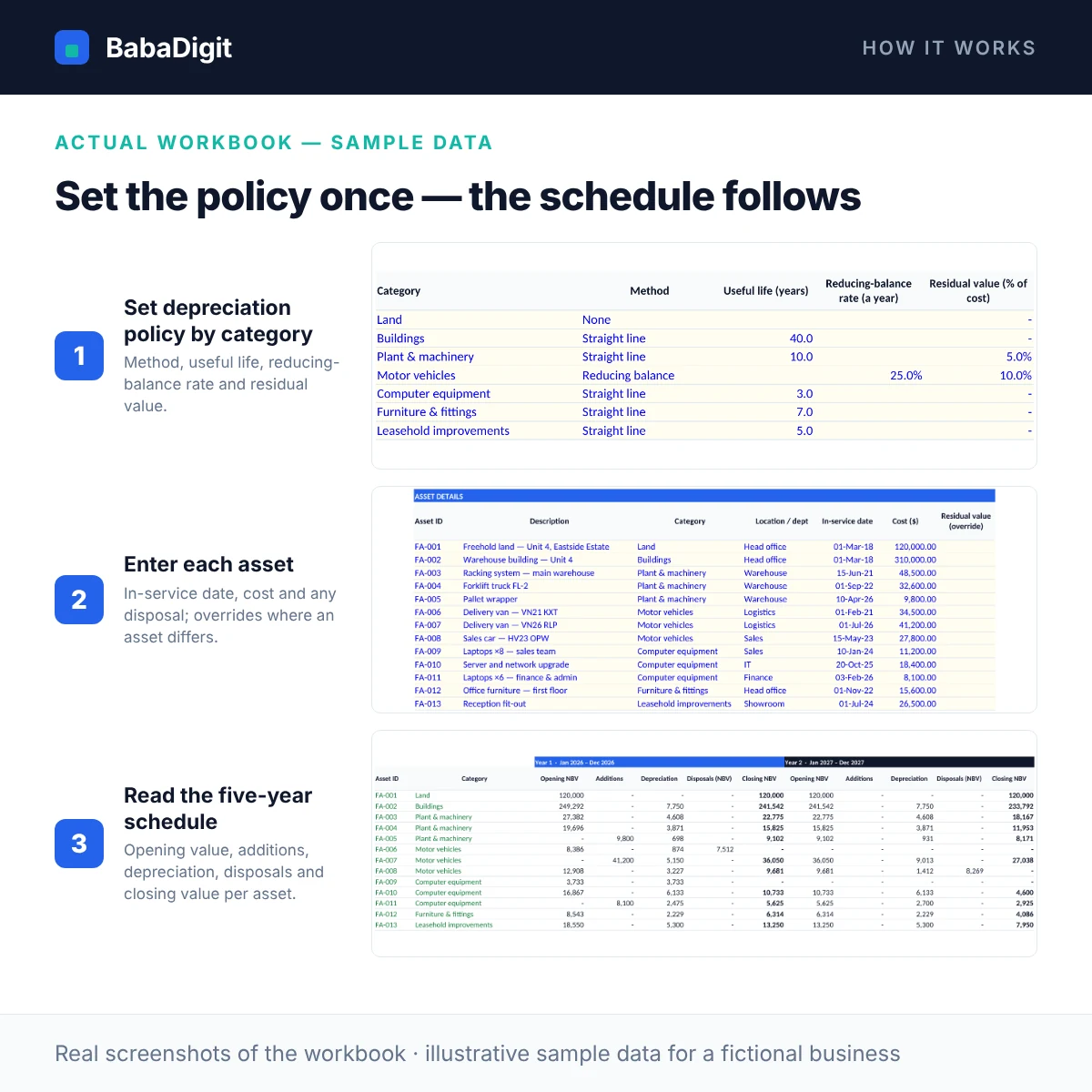
This template keeps them together. Set each category’s method, useful life, rate and residual value once; enter each asset with its in-service date and cost; and the depreciation is calculated month by month under the purchase and disposal conventions you choose. Assets bought before the schedule starts get their accumulated depreciation worked out too — or you can type the figure from your books.
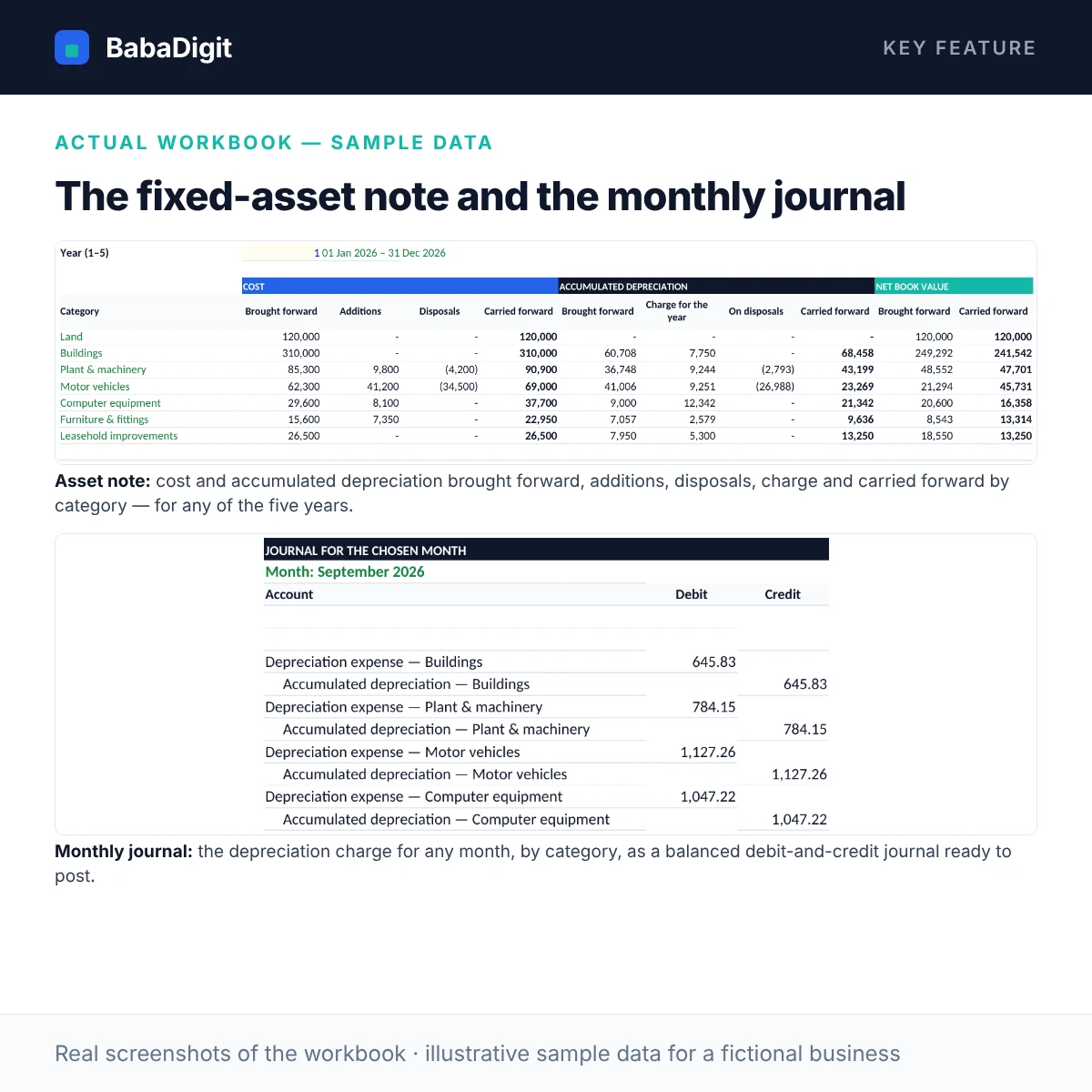
The Schedule sheet shows each asset’s opening value, additions, depreciation, disposals and closing net book value for five years. The Asset Note gives the cost and accumulated-depreciation roll-forward by category in the format used in financial statements, Monthly Charge produces the depreciation journal for any month, and Disposals lists every sale with its gain or loss.
What you get
- Register for up to 300 assets: ID, description, category, location, in-service date, cost, residual value, disposal date and proceeds
- Straight-line and reducing-balance depreciation, or none (e.g. land), set by category with per-asset overrides
- Month conventions for purchases and disposals, chosen on Setup
- Accumulated depreciation to date calculated for assets bought before Year 1 — or entered from your books
- Five-year schedule per asset: opening NBV, additions, depreciation, disposals, closing NBV
- Summary: NBV movement, cost and accumulated depreciation at each year end, charge and NBV by category, and a chart
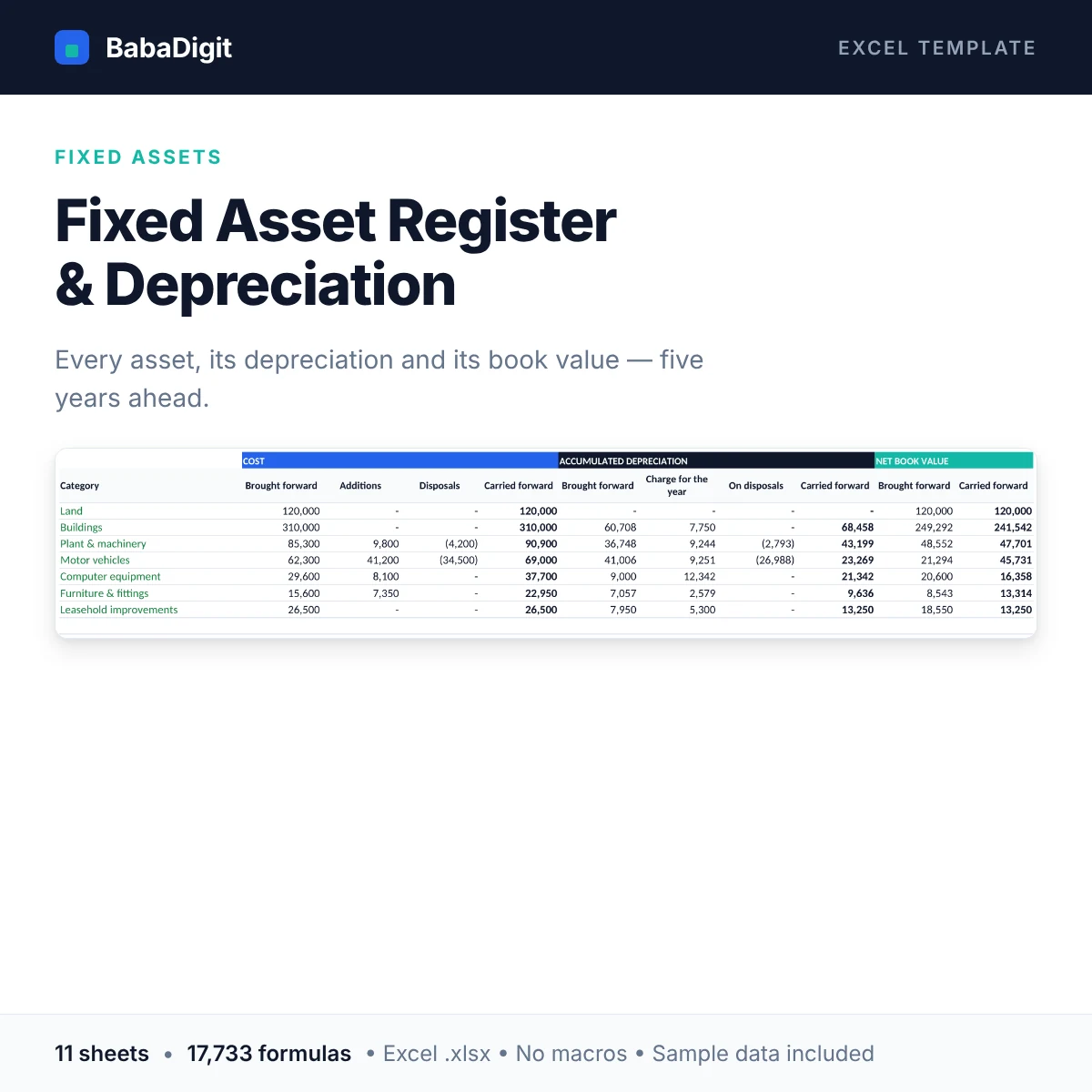
- Asset Note: cost and accumulated depreciation brought forward, additions, disposals, charge and carried forward by category, for any year
- Monthly Charge: depreciation by category for every month of a chosen year, and a balanced journal for any month
- Disposals report with gain or loss on disposal
- Nine checks, plus reconciliation checks on the Asset Note and Monthly Charge sheets
Sheets in the workbook
- Instructions — How to use the file, colour key, assumptions and limitations.
- Setup — Year 1 start date and month conventions.
- Categories — Default method, useful life, rate and residual value by category.
- Register — The asset register with calculated depreciation, net book value and status.
- Schedule — Five-year depreciation schedule, asset by asset.
- Summary — Movement by year and depreciation and net book value by category, with a chart.
- Asset Note — Cost and accumulated depreciation roll-forward by category for any year — the fixed-asset note format.
- Monthly Charge — Depreciation by category for each month of a chosen year, and a balanced journal for any month.
- Disposals — Assets sold or scrapped, with gain or loss on disposal.
- Checks — Plain-English data and reconciliation checks.
- Notes & Tests — How each key result is calculated, and test scenarios you can run yourself.
Who it is for
Accountants, bookkeepers, finance managers and business owners who maintain a fixed asset register for management accounts, year end and audit.
Practical uses
- Monthly or annual depreciation charge for the accounts
- Year-end fixed asset note and audit support
- Budgeting next year’s depreciation
- Recording disposals and their gain or loss
In the download
- BabaDigit_Fixed_Asset_Register.xlsx — 11 sheets
- README with the full usage guide
- Licence (own business and client use)
- Worked sample data for a fictional business, clearly labelled
Requirements
- Microsoft Excel 2016 or later, or Microsoft 365
- Also opens in LibreOffice Calc; Google Sheets and Apple Numbers import not yet tested
- No macros, no add-ins, no internet connection required
Please read
- Book depreciation only; tax depreciation (capital allowances) usually follows different rules.
- Revaluations and impairments are not modelled.
- Your accounting policies decide useful lives and methods; the template applies them.
- This is a tool, not financial, accounting, tax or legal advice.
Reviews
There are no reviews yet.