

Reading this result: you repay 637,411.34 in total on a 500,000.00 loan. The 137,411.34 of interest is 27.48% of the amount borrowed, paid out over 60 months.
General information only, not financial advice, and not an offer of credit. Lenders add fees and may calculate differently — always check the figures in your own agreement.
Free loan EMI calculator Excel workbook
The same method as the calculator above, in a spreadsheet you can keep, edit and share — with the first and last payment split, a rate-and-term grid and a side-by-side loan comparison.
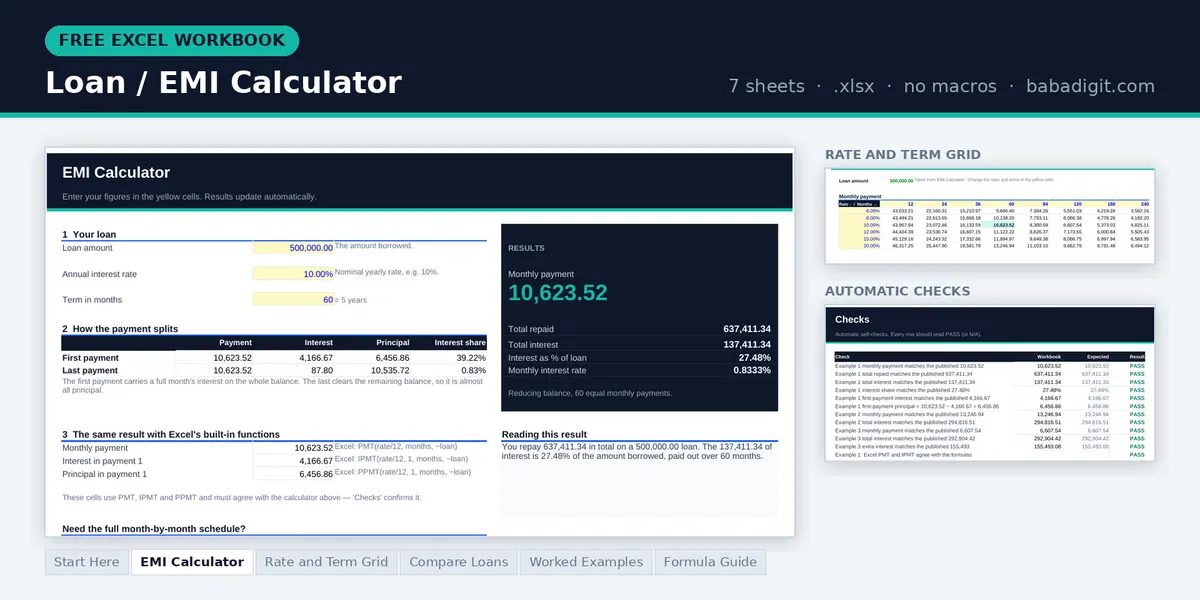
- EMI Calculator — loan amount, rate and term; monthly payment, total interest, first and last payment split
- Rate and Term Grid — the monthly payment across six rates and eight terms, from 1 to 20 years
- Compare Loans — four loan offers side by side by payment and total interest
- Worked examples, formula guide and checks — including Excel’s PMT, IPMT and PPMT functions
Opens in Microsoft Excel or LibreOffice Calc. General information only, not financial advice.
This free workbook stops at the payment and its split. The Loan Amortization Schedule Template is a paid spreadsheet that builds the full month-by-month schedule, with extra payments and the interest they save. Browse all templates
What an EMI actually is
EMI stands for equated monthly instalment — the fixed amount you pay every month until a loan is cleared. It is “equated” because the payment never changes, even though what it does changes considerably over the life of the loan.
Every payment splits in two. Part covers the interest accrued on the outstanding balance that month; the rest reduces the balance itself. Early on, the balance is large, so most of the payment goes to interest. As the balance falls, the interest portion shrinks and more of each identical payment goes to clearing the debt. This is amortisation, and it is why paying off a loan feels so slow at the start.
The consequence worth understanding: overpaying early is far more valuable than overpaying late, because it removes principal that would otherwise have accrued interest for the entire remaining term.
The EMI formula
EMI = [ P × r × (1 + r)n ] ÷ [ (1 + r)n − 1 ]P = loan amount, r = monthly rate (annual ÷ 12 ÷ 100), n = number of monthsThe monthly rate is the annual rate divided by twelve. A 10% annual rate is 0.8333% a month, or 0.008333 as a decimal. Getting this conversion wrong — using the annual rate directly — is the most common error, and it produces a wildly overstated payment.
Three worked examples
Base case
A five-year business loan
Borrowing $500,000 at 10% a year over 60 months.
n = 60
EMI = 10,623.52 a month
Total repaid = 10,623.52 × 60 = 637,411.34
Total interest = 137,411.34
The interest is 27.48% of the amount borrowed — not 50%, as multiplying 10% by five years might suggest. That is because the balance falls every month, so interest is charged on a shrinking amount rather than the original sum.
Rate matters
The same loan at 20%
Identical amount and term, but the rate doubles.
At 20%: EMI 13,246.94, interest 294,816.51
Doubling the rate raises the payment by 25% but more than doubles the interest. This is why a percentage point on the rate is worth negotiating hard for — the effect on total cost is far larger than the effect on the monthly figure you were shown.
The long-term trap
Stretching the same loan to ten years
$500,000 at 10%, but over 120 months instead of 60.
120 months: EMI 6,607.54, interest 292,904.42
The monthly payment falls by 38%, which is why longer terms are attractive when cash is tight. The total interest more than doubles — an extra $155,493 for the same money. A longer term buys breathing room and sells it back to you at a high price.
What the EMI figure leaves out
How the split changes over the term
| Stage of a 60-month loan | Interest portion | Principal portion |
|---|---|---|
| First payment | 4,166.67 | 6,456.86 |
| Around month 30 | Roughly half of the early figure | Correspondingly larger |
| Final payment | Almost nothing | Almost the whole payment |
On the $500,000 example, the very first payment carries $4,166.67 of interest — a full month’s interest on the entire balance — leaving $6,456.86 to reduce the debt. By the end, nearly the whole payment is principal. Same payment, completely different work.
How to calculate an EMI in Excel or Google Sheets
Loan amount in B1, annual rate in B2, months in B3:
=PMT(B2/12/100, B3, -B1)=IPMT(B2/12/100, 1, B3, -B1) ← interest in the first paymentThe minus sign on the loan amount returns a positive payment. IPMT and PPMT give the interest and principal parts of any individual payment, which is how you build a full amortisation schedule.
Frequently asked questions
Why is my lender’s figure slightly different?
Usually rounding, day-count conventions, or fees folded into the payment. Some lenders calculate on actual days rather than equal months, and many add insurance or processing charges to the instalment. Differences of a few units are normal; large gaps mean something is being charged that the rate alone does not capture.
Does paying extra actually help?
Substantially, and most in the early years. An overpayment reduces the balance immediately, so interest stops accruing on that amount for the entire remaining term. Check your agreement first — some loans carry early-repayment charges that offset part of the saving.
Should I choose a longer term for a lower payment?
Only if the shorter term genuinely does not fit your cash flow. The longer term reduces the monthly figure but increases total interest sharply, as the third example shows. If you take the longer term for safety, consider overpaying when you can — you get the flexibility without the full cost.
What is the difference between flat and reducing-balance interest?
Reducing balance charges interest on what you still owe, so the interest cost falls as you repay. Flat rate charges on the original amount for the whole term, which costs roughly twice as much for the same headline percentage. This calculator uses reducing balance, which is the standard for most term loans and mortgages.
Is the interest rate the same as APR?
No. APR includes compulsory fees and charges as well as the interest rate, which is why it is the fairer basis for comparing offers. Two loans with identical rates can have very different APRs. Ask for the APR, not just the rate.
Can I use this for a mortgage or car loan?
Yes — the arithmetic is identical for any fixed-rate amortising loan. Enter the amount, the annual rate and the term in months. For a variable-rate mortgage, treat the result as the payment at today’s rate and test it again at higher rates.
References
- Brealey, R. A., Myers, S. C. & Allen, F. Principles of Corporate Finance, 13th edition, McGraw-Hill Education — on annuities and loan amortisation.
- Bodie, Z., Kane, A. & Marcus, A. J. Investments, 12th edition, McGraw-Hill Education — on the time value of money and fixed-payment securities.
Keep going
Written and reviewed by Ghayas Uddin, MS (Finance), financial analyst. Last reviewed 21 September 2026. Found an error? Email support@babadigit.com and we will correct it.