
 Download the Personal Cash Flow Planner (.xlsx)
Designed and tested for Microsoft Excel. Opens with clearly labelled sample data you can clear. General information only, not financial advice.
What’s inside
- Setup — currency, first month, the cash you have now (opening balance) and your safety cushion.
- Plan — up to 8 income rows and 20 money-out rows for 12 months. Each closing balance becomes the next month’s opening balance, and every month is marked OK, Below cushion or Below zero.
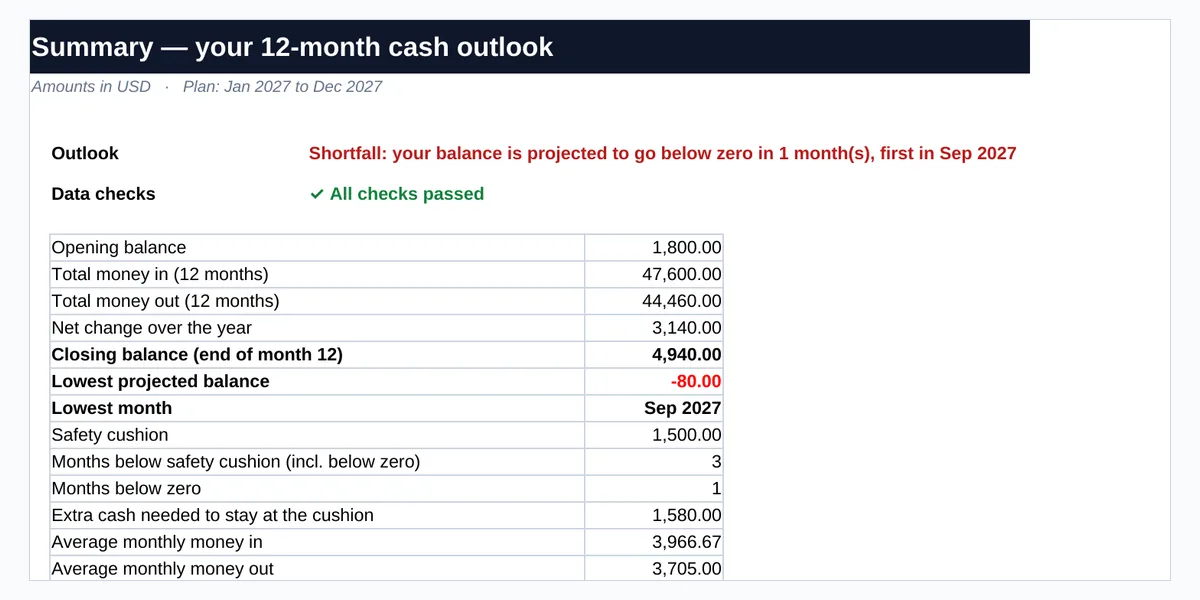
- Summary — an outlook message, your lowest projected balance and the month it happens, the first problem month, months below the cushion or below zero, the extra cash needed to stay at the cushion, and a chart.
- Checks — 13 data and reconciliation checks.
This is a personal and household cash planner. It is not a business cash flow statement.
How to use it
- Set your starting point. Enter the cash you have now and the lowest balance you are comfortable with (your safety cushion).
- Enter money in. Add each income source in the months you expect it. Irregular or freelance income goes only in the months it is likely to arrive.
- Enter money out. Add regular bills and put annual or one-off costs — insurance, school fees, holidays — in the month you will actually pay them.
- Read the outlook. The Summary shows whether your balance holds up. Update the plan each month as real figures replace estimates.
Example: spotting a shortfall early
The sample household starts with 1,800.00, sets a safety cushion of 1,500.00 and has irregular freelance income. A July holiday and September school fees pull the balance down:
Lowest projected balance −80.00 (Sep 2027)
Months below the cushion 3
Extra cash needed 1,580.00
Seeing this in January gives time to act — for example moving a payment, setting money aside each month, or planning extra income — instead of finding out in September.
Frequently asked questions
What is a personal cash flow forecast?
A month-by-month estimate of the money coming in and going out of your household, and the balance you will have at the end of each month. It shows whether you can cover upcoming bills, not just whether you are within budget.
How is this different from the Personal Budget Planner?
The budget planner sets spending targets by category and compares them with what you actually spent. The cash flow planner focuses on your bank balance over time, so you can see a low month coming. Many people use both.
How do I handle irregular income?
Enter it only in the months you reasonably expect it, and leave other months blank. Being cautious with uncertain income gives a more reliable warning.
What is a safety cushion?
The lowest balance you want to keep for surprises. The planner flags any month that dips below it, and tells you how much extra cash would keep you at the cushion all year.
Does it work in Google Sheets?
The workbook is designed and tested primarily for Microsoft Excel. It can be opened in other spreadsheet applications, but some features may behave differently.
Related free resources
This workbook is a planning tool, not financial advice. It only knows what you enter. Written and reviewed by Ghayas Uddin, MS (Finance), financial analyst. Last reviewed 5 October 2026. Found an error? Email support@babadigit.com.