
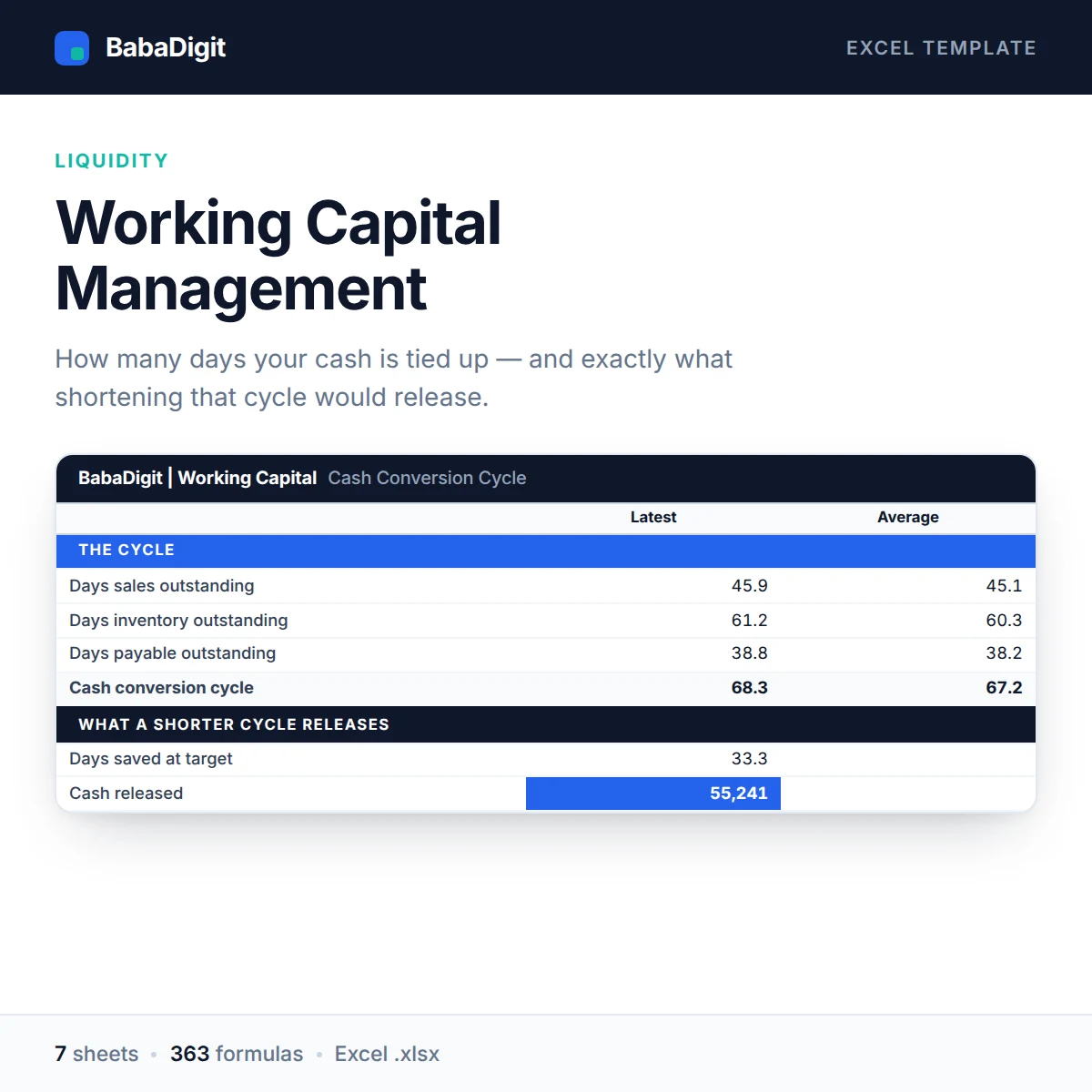

Most businesses that run short of cash are not unprofitable. Their money is sitting in stock nobody has bought and invoices nobody has paid, while suppliers want paying now. The cash conversion cycle measures exactly that, in days.
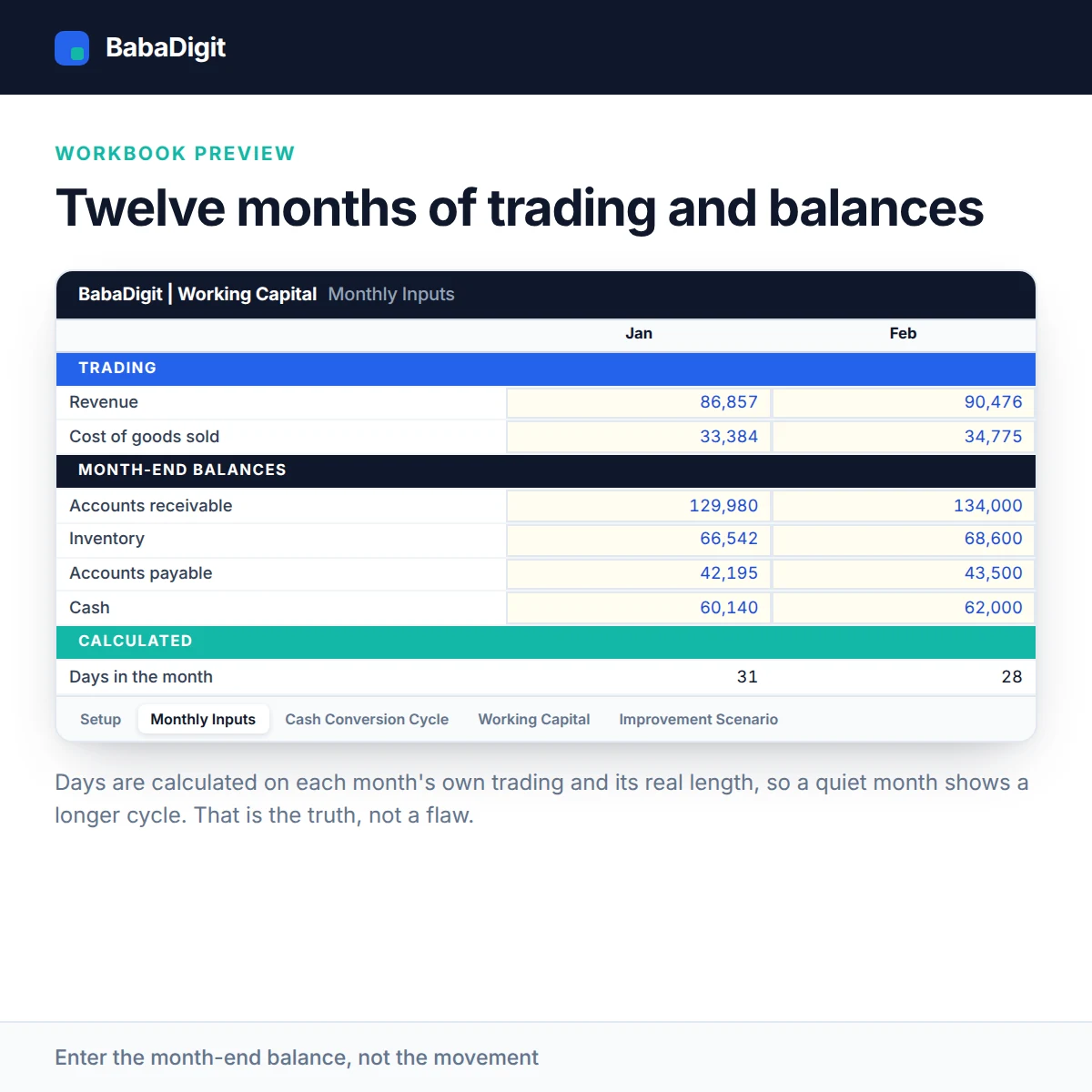
This template calculates DSO, DIO and DPO for each of twelve months from your own revenue, cost of sales and month-end balances, and combines them into the cycle. Because it uses each month’s own trading and the real number of days in that month, a quiet month shows a longer cycle — which is the truth, not a flaw.
The Working Capital sheet shows what the cycle costs you: current assets against current liabilities, working capital with and without cash, and the current and quick ratios.
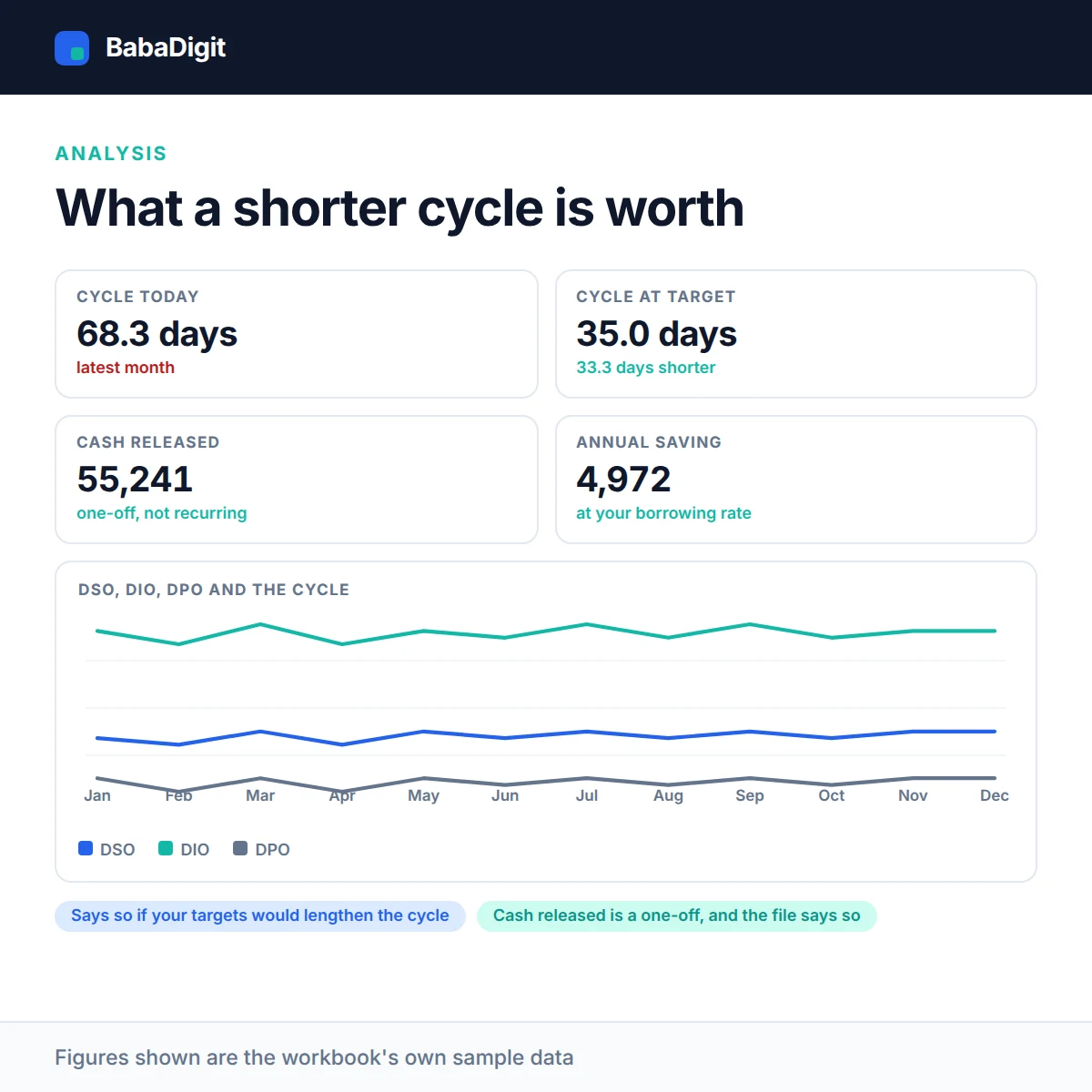
Then the Improvement Scenario does the part that matters. You set the days you think you could realistically achieve, and the sheet values the difference — how much cash each day released is worth, what the total comes to, and what it saves annually at your own borrowing rate. If your targets would actually lengthen the cycle, it says so rather than reporting a saving that is not there.
What you get
- Twelve-month DSO, DIO, DPO and cash conversion cycle
- Days calculated on each month’s real length
- Current assets, current liabilities, working capital with and without cash
- Current ratio and quick ratio
- Improvement scenario valuing days released in cash
- Annual borrowing saving on the cash released
- Four-line cycle chart
- Configurable currency — no currency is hard-coded
- No country’s tax rates or statutory rules built in
- Sheets protected without a password
- No macros, no add-ins, no internet connection required
Who it is for
Finance managers, business owners and credit controllers who need to free cash from the balance sheet rather than raise it.
In the download
- Excel workbook, fully formula-driven
- README with the full usage guide
- Licence covering commercial and client use
- Worked sample data throughout, clearly labelled
Sheets in the workbook
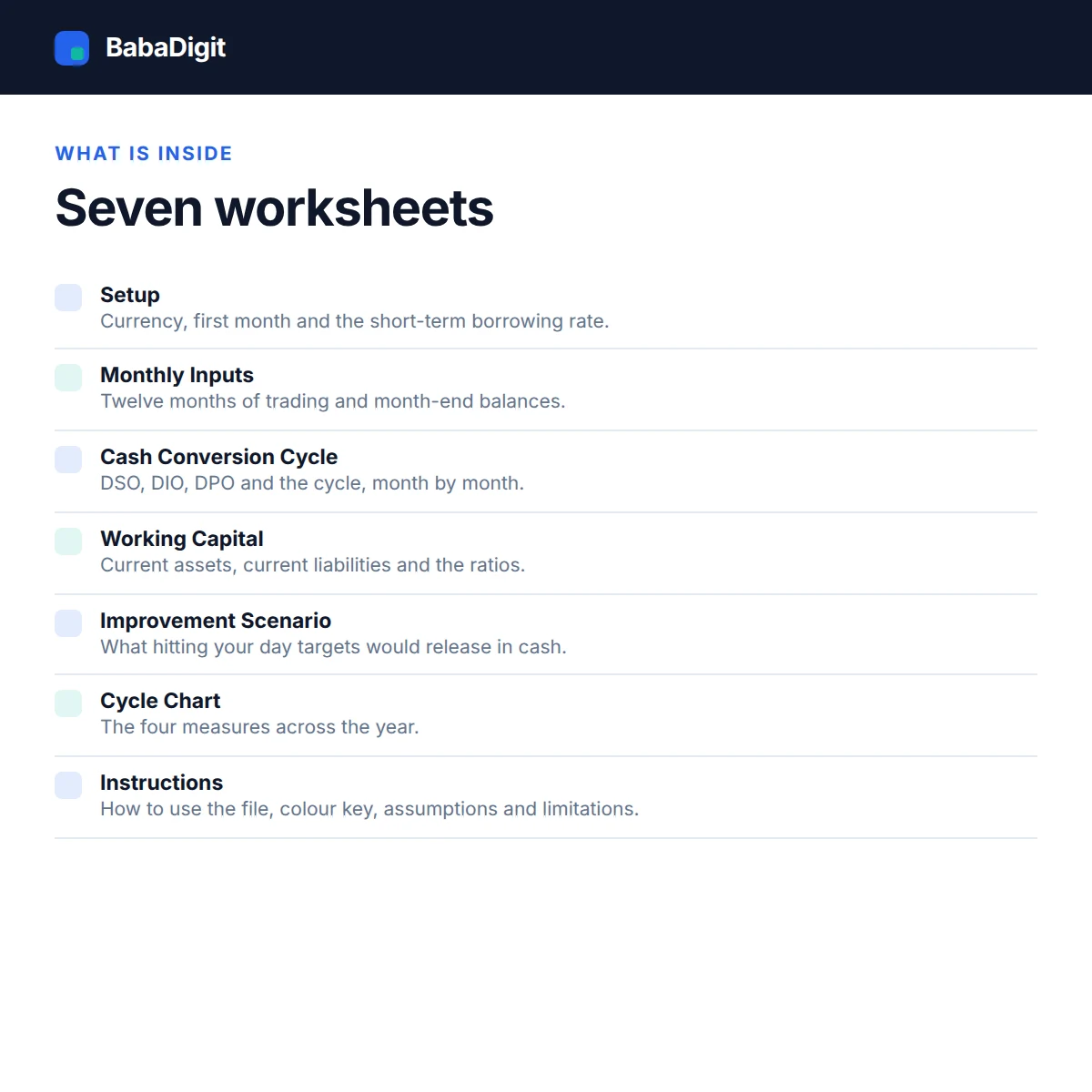
- Instructions — How to use the file, colour key, assumptions and limitations.
- Setup — Currency, first month and the short-term borrowing rate.
- Monthly Inputs — Twelve months of trading and month-end balances.
- Cash Conversion Cycle — DSO, DIO, DPO and the cycle, month by month.
- Working Capital — Current assets, current liabilities and the ratios.
- Improvement Scenario — What hitting your day targets would release in cash.
- Cycle Chart — The four measures across the year.
Requirements
- Microsoft Excel 2016 or later, or Microsoft 365
- Also opens in LibreOffice Calc, Google Sheets (import) and Apple Numbers
- No macros, no add-ins, no internet connection required
Please read
- A measurement tool, not financial, accounting or legal advice.
- Cash released is a one-off benefit, not a recurring saving. It happens once, when the cycle shortens, and reverses if the improvement is not held.
- Seasonal businesses should read the twelve-month average rather than any single month.
- Check the figures against your own ledgers before acting on them.
- Sample data is included and clearly labelled. It is illustrative only.
- This is a tool, not financial, accounting, tax or legal advice.
Reviews
There are no reviews yet.