
Reading this result: after 10 years, 10,000.00 grows to 16,470.09.
Year-by-year balance
| Year | Put in to date | Interest to date | Balance |
|---|
General information only, not financial advice. Assumes a fixed rate with no tax, fees or inflation.
Free compound interest calculator Excel workbook
The same method as the calculator above, in a spreadsheet you can keep, edit and share — with every compounding frequency side by side, the rule of 72 and a year-by-year table for up to 100 years.
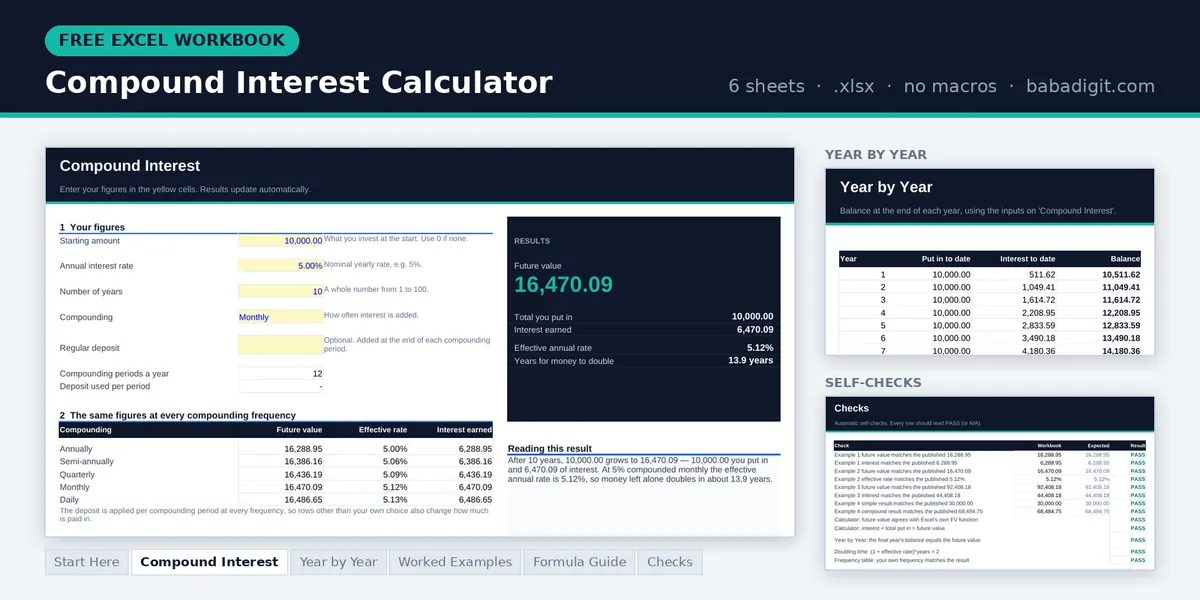
- Compound Interest — future value, money put in, interest, effective annual rate and doubling time, plus a frequency comparison
- Year by Year — deposits, interest and balance at the end of every year
- Worked examples — the four examples from this page, rebuilt
- Formula guide and checks — including an independent check against Excel’s own FV function
Opens in Microsoft Excel or LibreOffice Calc. General information only, not financial advice.
Compound interest works against you on debt too. The Loan Amortization Schedule Template is a paid spreadsheet that shows how each repayment splits between interest and principal. Browse all templates
How compound interest works
With compound interest, the interest earned in each period is added to the balance, and the next period’s interest is paid on the new, larger balance. The longer the money is left, the more of each year’s growth comes from interest that has itself earned interest — which is why the year-by-year table above curves upwards instead of rising in a straight line.
Enter a starting amount, the annual rate, the number of years and how often interest is added. If you save regularly, add the deposit you make each period; it is treated as paid at the end of each compounding period.
The compound interest formula
FV = P × (1 + r÷n)^(n×t) + D × ((1 + r÷n)^(n×t) − 1) ÷ (r÷n)Effective annual rate = (1 + r÷n)^n − 1P is the starting amount, r the annual rate as a decimal, n the number of compounding periods a year, t the number of years and D the deposit made at the end of each period. At a 0% rate the future value is simply everything you put in.
Four worked examples
A single amount
10,000 for 10 years at 5%
10,000 is invested at 5% a year, compounded annually, and left alone.
Interest = 16,288.95 − 10,000 = 6,288.95
The money grows by 62.9%, not the 50% that ten years of simple 5% interest would give.
Compounding frequency
The same deposit, compounded monthly
The same 10,000 at 5% for 10 years, but with interest added every month.
Effective = (1 + 0.05÷12)^12 − 1 = 5.12%
Monthly compounding adds 181.14 over ten years — worth having, but small next to the rate itself.
Regular saving
200 a month for 20 years at 6%
Starting from nothing, 200 is saved at the end of every month at 6% compounded monthly.
FV = 200 × (1.005^240 − 1) ÷ 0.005 = 92,408.18
Interest = 44,408.18
Almost half of the final balance is interest, and most of that is earned in the last few years.
Simple vs compound
25 years at 8%
10,000 earns 8% a year for 25 years.
Compound: 10,000 × 1.08^25 = 68,484.75
Compounding more than doubles the result. Over long periods, time does most of the work.
How much does compounding frequency matter?
10,000 at 6% for 10 years, with interest added at different intervals:
| Compounded | Value after 10 years |
|---|---|
| Annually | 17,908.48 |
| Semi-annually | 18,061.11 |
| Quarterly | 18,140.18 |
| Monthly | 18,193.97 |
| Daily | 18,220.29 |
Moving from annual to daily compounding adds 311.81 — about 1.7%. Raising the rate by just half a point would add far more. When you compare savings accounts, compare the effective annual rate, which already includes the compounding.
The rule of 72
Divide 72 by the annual rate to estimate how many years money takes to double. It is a mental shortcut, close for everyday rates:
| Annual rate (compounded yearly) | Exact years to double | Rule of 72 |
|---|---|---|
| 2% | 35.0 | 36.0 |
| 4% | 17.7 | 18.0 |
| 6% | 11.9 | 12.0 |
| 8% | 9.0 | 9.0 |
| 10% | 7.3 | 7.2 |
| 12% | 6.1 | 6.0 |
Exact doubling time = ln 2 ÷ ln(1 + rate). The calculator above shows it for your inputs.
Do it in a spreadsheet
Spreadsheets have a built-in future value function. With the annual rate as a decimal in B1, years in B2, periods a year in B3, the starting amount in B4 and the deposit per period in B5:
- Future value:
=FV(B1/B3,B2*B3,-B5,-B4) - Effective annual rate:
=(1+B1/B3)^B3-1 - Years to double:
=LN(2)/LN(1+B1)for yearly compounding.
The minus signs follow the spreadsheet convention that money paid in is negative. For growth over past periods rather than a forecast, use the CAGR Calculator.
Frequently asked questions
What is compound interest?
Compound interest is interest earned on interest. Each period, the interest is added to the balance, and the next period’s interest is worked out on that larger balance. Over long periods this makes the balance grow faster and faster, unlike simple interest, which is only ever paid on the original amount.
What is the compound interest formula?
For a single amount: FV = P × (1 + r ÷ n)^(n × t), where P is the starting amount, r the annual rate as a decimal, n the number of compounding periods a year and t the number of years. With a regular deposit D at the end of each period, add D × ((1 + r ÷ n)^(n × t) − 1) ÷ (r ÷ n).
Does compounding more often make a big difference?
Some, but less than people expect. 10,000 at 6% for 10 years grows to 17,908.48 with annual compounding and 18,220.29 with daily compounding — a difference of about 1.7%. The rate and the time matter far more than the frequency.
What is the difference between the nominal rate and the effective annual rate?
The nominal rate is the headline annual rate before compounding. The effective annual rate is what you actually earn in a year once compounding is included: (1 + r ÷ n)^n − 1. A 5% rate compounded monthly is 5.12% effective. When you compare accounts, compare effective rates.
What is the rule of 72?
A quick way to estimate how long money takes to double: divide 72 by the annual rate. At 8%, 72 ÷ 8 = 9 years. It is close for rates between about 4% and 12%; this calculator shows the exact doubling time instead.
Does compound interest work against me on debt?
Yes. Unpaid interest on a loan or credit card is usually added to the balance and then charged interest itself, so the same arithmetic that grows savings grows debt. The Loan / EMI Calculator shows how repayments split between interest and principal.
Does this calculator include tax, fees or inflation?
No. It shows the arithmetic of compounding at a fixed rate. Real returns are reduced by tax, account fees and inflation, and investment returns are not fixed — treat the result as an illustration, not a forecast.
Keep going
Written and reviewed by Ghayas Uddin, MS (Finance), financial analyst. Last reviewed 4 October 2026. Found an error? Email support@babadigit.com and we will correct it.