
Assumptions appear here once every field is valid.
Reading this result: to have 20,000.00 in 5 years at 6% compounded monthly, you need 14,827.44 today.
General information only, not financial advice. Assumes one fixed rate with no tax, fees or inflation.
Free present and future value Excel workbook
The same method as the calculator above, in a spreadsheet you can keep, edit and share — with a regular-contributions sheet for savings plans and payment streams, and every result checked against Excel’s own PV and FV functions.
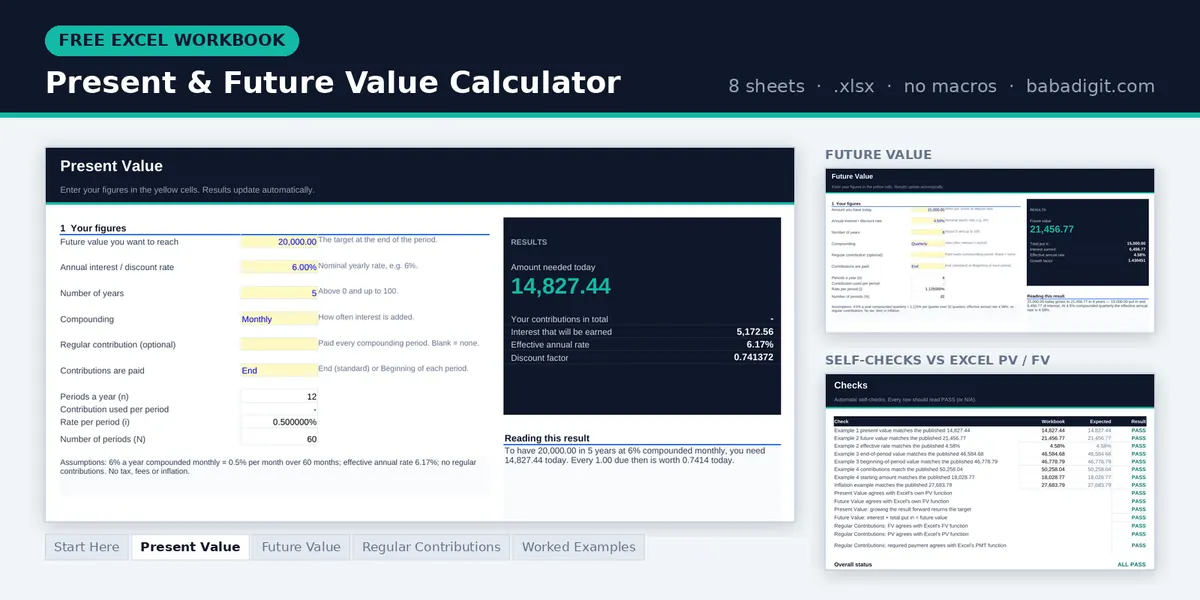
- Present Value and Future Value — both directions, any compounding, contributions at the beginning or end of each period
- Regular Contributions — what a stream of payments grows to, what it is worth today, and the payment needed for a target
- Assumptions & Reference — the compounding convention, effective rates and an inflation table
- Worked examples, formula guide and checks — the examples from this page, rebuilt, plus independent self-tests
Opens in Microsoft Excel or LibreOffice Calc. General information only, not financial advice.
Valuing a whole project rather than a single amount? The Investment Appraisal Template is a paid spreadsheet that lays out year-by-year free cash flow with NPV, IRR, MIRR, payback and profitability index, plus Base, Best and Worst scenarios. Browse all templates
Present value and future value
Money has a time value: an amount you hold today can earn interest, so it is worth more than the same amount received later. Future value answers “what will this grow to?”; present value answers “what is that future amount worth now?” — or, put practically, “how much do I need to set aside today?”
Both use the same ingredients: an annual rate, how often interest is compounded, how long the money is invested, and any regular contributions along the way. Choose Present value when you start from a target, and Future value when you start from what you have.
The core formulas
i = annual rate ÷ n N = n × yearsFV = PV × (1 + i)^N + C × APV = (FV − C × A) ÷ (1 + i)^NA = ((1 + i)^N − 1) ÷ i for end-of-period contributions; × (1 + i) for beginning-of-period; A = N at 0%n is the number of compounding periods a year and C the contribution made every period. The calculator assumes contributions are made as often as interest is compounded — monthly contributions with monthly compounding, yearly with yearly — and applies no rounding until the result is displayed.
Compounding frequency and the effective annual rate
A nominal rate of 6% compounded monthly adds 0.5% each month, and interest then earns interest within the year. The rate you really earn — the effective annual rate — is (1 + r ÷ n)^n − 1:
| 6% nominal, compounded | Effective annual rate |
|---|---|
| Annually | 6.00% |
| Semi-annually | 6.09% |
| Quarterly | 6.14% |
| Monthly | 6.17% |
| Daily | 6.18% |
When you compare savings accounts or loans, compare effective rates; nominal rates with different compounding are not directly comparable. For present value the same logic works in reverse: more frequent compounding means a future amount is worth slightly less today.
Four worked examples
Present value
How much to set aside for a goal
You want 20,000 in 5 years, and can earn 6% compounded monthly.
PV = 20,000 ÷ 1.005^60 = 14,827.44
Setting aside 14,827.44 today reaches the goal. The other 5,172.56 is interest.
Future value
A lump sum left to grow
15,000 is invested for 8 years at 4.5% compounded quarterly.
FV = 15,000 × 1.01125^32 = 21,456.77
The deposit grows by 6,456.77. The effective annual rate is 4.58%.
Regular saving
300 a month: end vs beginning of each month
300 is saved every month for 10 years at 5% compounded monthly, starting from nothing.
Beginning: 46,584.68 × 1.0041667 = 46,778.79
Paying at the start of each month earns 194.11 more, because every payment has one extra month of interest.
Present value with contributions
How much to start with if you also save
You want 100,000 in 15 years at 7% compounded annually, and will add 2,000 at the end of each year.
Still needed = 100,000 − 50,258.04 = 49,741.96
PV = 49,741.96 ÷ 1.07^15 = 18,028.77
Starting with 18,028.77 plus the yearly contributions reaches 100,000. The 30,000 you contribute and the starting amount earn 51,971.23 of interest between them.
Inflation and purchasing power
A future value is measured in future money. If prices rise, the same amount buys less. To express a future amount in today’s purchasing power, use the Present value mode with the inflation rate as the rate. For 50,000 received in 20 years:
| Inflation | Worth today after 10 years | Worth today after 20 years |
|---|---|---|
| 2% a year | 41,017.41 | 33,648.57 |
| 3% a year | 37,204.70 | 27,683.79 |
| 5% a year | 30,695.66 | 18,844.47 |
Illustrative inflation rates, compounded annually. Actual inflation varies from year to year and between countries.
A useful rule of thumb: the real growth rate of your money is roughly the interest rate minus inflation. A 5% return with 3% inflation grows purchasing power by only about 2% a year.
Loans and investment decisions
Present value is how lenders and analysts think. The amount you can borrow is the present value of your repayments at the loan rate: repaying 500 a month for 5 years at 8% supports a loan of about 24,659. The Loan / EMI Calculator works the other way, from the loan to the monthly payment.
For investments, comparing the present value of the money a project returns with what it costs today is the basis of net present value. When the cash flows differ from year to year, use the NPV Calculator; to measure the growth rate an investment actually achieved, use the CAGR Calculator.
Do it in a spreadsheet
Excel and Google Sheets have built-in functions. With the annual rate as a decimal in B1, years in B2, periods a year in B3, the contribution per period in B4, the amount today in B5, the target in B6 and the timing (0 = end, 1 = beginning) in B7:
- Future value:
=FV(B1/B3,B2*B3,-B4,-B5,B7) - Present value of a target:
=-PV(B1/B3,B2*B3,-B4,B6,B7) - Effective annual rate:
=(1+B1/B3)^B3-1
The minus signs follow the spreadsheet convention that money you pay in is negative and money you receive is positive.
Frequently asked questions
What is the difference between present value and future value?
Future value is what an amount today grows to at a given rate over time. Present value runs the other way: what a future amount is worth today, or how much you need to set aside now to reach it. They are the same formula rearranged: FV = PV × (1 + i)^N and PV = FV ÷ (1 + i)^N.
What discount rate should I use for present value?
Use the return you could realistically earn elsewhere on money of similar risk — for savings, the rate on a comparable account; for a business decision, the company’s required return. A higher rate makes a future amount worth less today. Results are only as reliable as the rate you choose.
What is the difference between beginning- and end-of-period contributions?
End-of-period contributions are paid at the end of each period, so the last one earns no interest — the standard for most savings plans and loan repayments. Beginning-of-period contributions are paid at the start, so each one earns one extra period of interest. Saving 300 a month for 10 years at 5% grows to 46,584.68 at the end of each month and 46,778.79 at the beginning.
What is the effective annual rate?
The rate you actually earn in a year once compounding is included: (1 + r ÷ n)^n − 1, where r is the nominal annual rate and n the number of compounding periods a year. 6% compounded monthly is 6.17% effective.
How does inflation affect future value?
A future value is in future money. To see what it would buy in today’s prices, discount it at the inflation rate: 50,000 in 20 years is worth 27,683.79 in today’s money if prices rise 3% a year. A real return is roughly the interest rate minus inflation.
How is present value used for loans?
The amount a lender will advance is the present value of your repayments at the loan rate. 500 a month for 5 years at 8% has a present value of about 24,659 — the loan those payments can repay. The Loan / EMI Calculator works the other way, from the loan to the payment.
Does this calculator include tax, fees or variable returns?
No. It applies one fixed rate for the whole period with no tax, charges or inflation. Real investment returns vary from year to year, so treat the result as an illustration, not a forecast.
Keep going
Written and reviewed by Ghayas Uddin, MS (Finance), financial analyst. Last reviewed 4 October 2026. Found an error? Email support@babadigit.com and we will correct it.