

Reading this result: EBITDA of 270,000.00 is 150,000.00 higher than net income, because interest, tax and non-cash charges have been added back. Those costs are still real.
General information only, not financial advice. Check any figure before you act on it.
Free EBITDA calculator Excel workbook
The same method as the calculator above, in a spreadsheet you can keep, edit and share — with the build-up from net income, an adjusted-EBITDA reconciliation and an EBITDA-to-cash bridge.
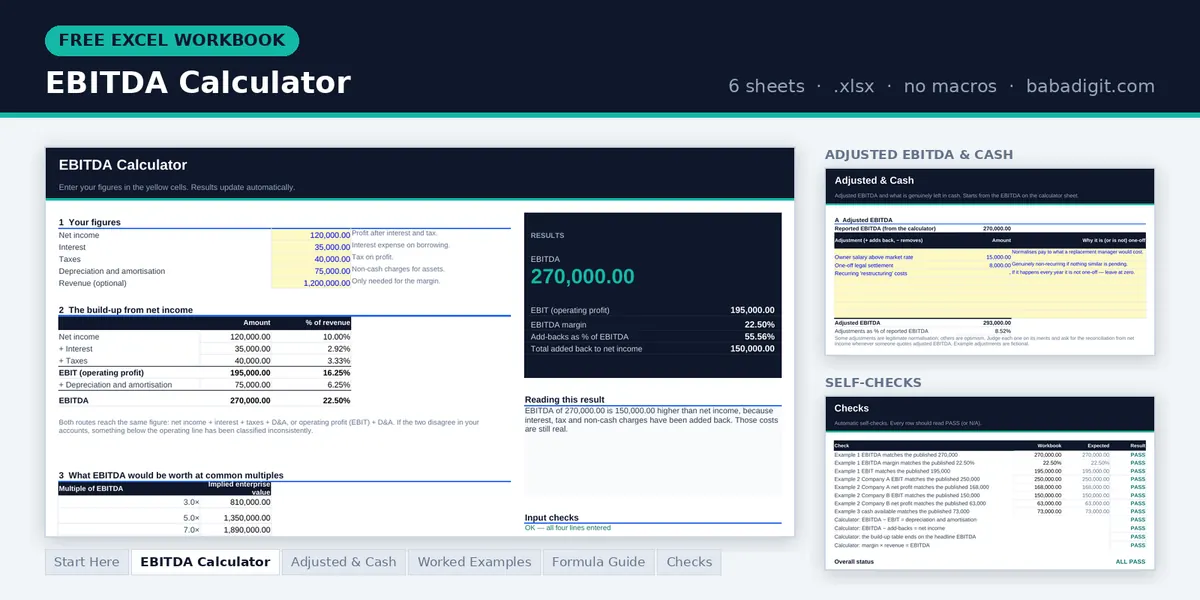
- EBITDA Calculator — EBITDA, EBIT, EBITDA margin and add-backs, with the build-up from net income
- Adjusted & Cash — an adjusted-EBITDA reconciliation and the cash genuinely left after capex, interest and tax
- Worked examples — two companies with identical EBITDA and very different net profit
- Formula guide and checks — the maths in plain English, plus built-in self-tests
Opens in Microsoft Excel or LibreOffice Calc. General information only, not financial advice.
EBITDA is only one line of the picture. The Financial Model Template is a paid spreadsheet that links a five-year P&L, balance sheet and cash flow from one assumptions sheet. Browse all templates
What EBITDA actually measures
EBITDA is earnings before interest, taxes, depreciation and amortisation. You take net profit and add back four things the business paid or recorded, on the argument that none of them tells you much about how well the underlying operation performs.
The reasoning is defensible. Interest depends on how the business was funded, not how it trades. Tax depends on jurisdiction and structure. Depreciation and amortisation are accounting entries that move no cash this year — they spread the cost of things bought in earlier years. Strip all four out and you can compare two companies’ operations more directly, even if one is heavily borrowed and the other owns everything outright.
That is why buyers, lenders and private equity all quote it, and why business valuations are usually expressed as a multiple of EBITDA. It is also why it is the most criticised figure in finance: the costs you added back have not gone anywhere.
The EBITDA formula
EBITDA = Net income + Interest + Taxes + Depreciation + Amortisationor, from the top: EBITDA = Operating profit (EBIT) + Depreciation + AmortisationBoth routes reach the same figure. Working up from net income is easier when all you have is a finished profit and loss account; working down from operating profit is quicker when the accounts are already laid out that way. If the two disagree, something below the operating line has been classified inconsistently.
Three worked examples
The build-up
From net income to EBITDA
A company reports $120,000 net income on $1,200,000 of revenue, after $35,000 interest, $40,000 tax and $75,000 of depreciation and amortisation.
+ Interest 35,000
+ Taxes 40,000
+ D&A 75,000
EBITDA 270,000 → margin 22.50%
EBIT 195,000
EBITDA is more than twice net income. That gap is not profit the business hid — it is interest genuinely paid, tax genuinely owed, and assets genuinely wearing out. Quoting the larger number is legitimate; forgetting what it excludes is not.
Why buyers use it
Two companies, identical EBITDA
Both generate $270,000 of EBITDA. One is debt-free with newer, lighter assets; the other is borrowed and capital-heavy. Tax is 30%.
EBIT 250,000 → pre-tax 240,000 → tax 72,000 → net 168,000
Company B: D&A 120,000, interest 60,000
EBIT 150,000 → pre-tax 90,000 → tax 27,000 → net 63,000
Identical EBITDA, and A earns almost three times B’s net profit. To a buyer planning to refinance the debt and who believes the asset base is sound, EBITDA is the fairer comparison. To an owner living off the business today, the $63,000 is what actually exists.
The criticism
When depreciation is telling the truth
Company B above shows $120,000 of annual depreciation. Suppose its equipment genuinely needs $110,000 a year of replacement spending to keep running.
− Real replacement spend 110,000
− Interest actually paid 60,000
− Tax actually paid 27,000
Cash genuinely available = 73,000
The $270,000 headline becomes $73,000 of real money. Depreciation was not an accounting fiction here — it was a reasonable estimate of assets being consumed. Adding it back is only honest when the business does not actually need to spend that money to keep going.
Where EBITDA misleads you
EBITDA, EBIT and net income compared
| Measure | Excludes | Best for |
|---|---|---|
| EBITDA | Interest, tax, depreciation, amortisation | Comparing operations; valuation multiples |
| EBIT | Interest and tax only | Operating performance including asset consumption |
| Net income | Nothing | What the owners actually keep |
EBIT is the underrated middle option. It strips out funding and tax differences, which is what makes cross-company comparison fair, while still charging the business for assets being used up. For most owner-run businesses it is the more honest headline than EBITDA.
How to calculate EBITDA in Excel or Google Sheets
Net income in B1, interest B2, tax B3, depreciation and amortisation B4, revenue B5:
=SUM(B1:B4) ← EBITDA=SUM(B1:B3) ← EBIT=SUM(B1:B4)/B5 ← EBITDA marginDepreciation and amortisation are usually listed in the cash flow statement or in the notes rather than on the face of the profit and loss account, so that is where to look if the number is not obvious.
Frequently asked questions
What is a good EBITDA margin?
It varies widely by sector. Ten to fifteen percent is respectable in most trading businesses, twenty-plus is strong, and software or licensing can run far higher. The margin only means something against direct competitors and against the company’s own trend.
Is EBITDA the same as cash flow?
No, and treating it as such is the most common error. EBITDA ignores capital spending, working capital movements, interest and tax — all of which consume real cash. A business can report rising EBITDA while running out of money. For cash, read the cash flow statement.
Why do buyers value businesses on EBITDA?
Because a buyer will replace the existing funding and inherit a different tax position, so interest and tax under current ownership are not relevant to them. EBITDA approximates what the operation earns independently of who owns it. Multiples typically run from three to ten times depending on sector, size and growth.
What is adjusted EBITDA?
EBITDA with further items removed — restructuring costs, legal settlements, share-based payments, owner perks. Some adjustments are legitimate normalisation; others are optimism. Always ask for the reconciliation from net income and judge each add-back on its merits.
Can EBITDA be negative?
Yes, and it is serious. It means the business lost money before any funding cost, tax or non-cash charge was even considered — the operation itself consumes more than it earns. Early-stage companies often show negative EBITDA deliberately while investing in growth.
Should a small business owner use EBITDA?
Use it when selling or raising finance, because that is the language buyers and lenders speak. For running the business day to day, operating profit and cash flow are more useful, because you actually have to pay the interest, the tax and the equipment replacement that EBITDA sets aside.
References
- Brealey, R. A., Myers, S. C. & Allen, F. Principles of Corporate Finance, 13th edition, McGraw-Hill Education — on earnings measures and valuation multiples.
- Damodaran, A. Investment Valuation: Tools and Techniques for Determining the Value of Any Asset, 3rd edition, Wiley — on relative valuation and the limits of EBITDA.
Keep going
Written and reviewed by Ghayas Uddin, MS (Finance), financial analyst. Last reviewed 21 September 2026. Found an error? Email support@babadigit.com and we will correct it.