
Assumptions: 40 hours a week × 52 paid weeks = 2,080 paid hours a year.
Reading this result: a salary of 52,000.00 is 25.00 an hour.
General information only. Gross pay before tax, overtime and deductions. Check any figure before you act on it.
Free salary to hourly rate Excel workbook
The same method as the calculator above, in a spreadsheet you can keep, edit and share — with both directions side by side, every assumption visible, and a reference table of common schedules.
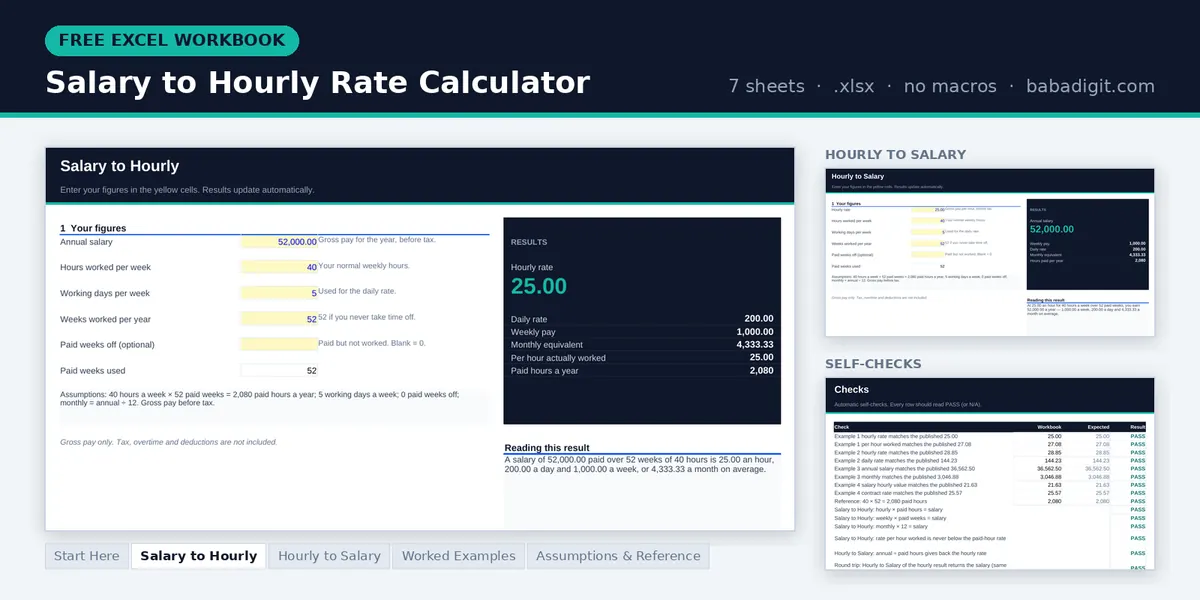
- Salary to Hourly — hourly, daily, weekly and monthly pay, plus the rate per hour actually worked
- Hourly to Salary — weekly, daily, monthly and annual pay from an hourly rate
- Assumptions & Reference — paid hours a year for common schedules, and every formula used
- Worked examples and checks — the four examples from this page, rebuilt, plus built-in self-tests
Opens in Microsoft Excel or LibreOffice Calc. General information only.
Running pay for a team? The Payroll Management Template is a paid spreadsheet for organising payroll. Browse all templates
Salary or hourly pay?
A salary is a fixed amount for the year, usually paid in equal monthly or fortnightly instalments whatever the exact hours in a given week. Hourly pay depends on the hours you actually record. Converting between the two is how you compare a job offer with a contract rate, price your own time, or check that a pay rise is what it appears to be.
The conversion is simple arithmetic, but it rests on three assumptions: how many hours make up a working week, how many weeks are paid, and how many of those weeks are actually worked. The calculator shows those assumptions under the inputs so the result is never a black box.
The core formulas
Paid weeks = weeks worked + paid weeks offHourly rate = Salary ÷ (hours per week × paid weeks)Salary = Hourly rate × hours per week × paid weeksDaily rate = Weekly pay ÷ working days per weekMonthly = Annual ÷ 12Turning a salary into an hourly rate
Divide the salary by the number of paid hours in the year. For a standard full-time job of 40 hours over 52 weeks that is 2,080 hours, so a 52,000 salary works out at 25.00 an hour. A 37.5-hour week gives 1,950 hours, and the same salary is then 26.67 an hour — shorter contracted hours mean a higher hourly value for the same pay.
If part of the year is paid leave, there is a second, equally valid figure: the rate per hour you actually work. With 4 weeks of paid holiday, the 52,000 salary covers only 48 working weeks, so each hour worked earns 27.08. Both figures appear in the calculator when you enter paid weeks off.
Turning an hourly rate into a salary
Multiply the hourly rate by the hours per week and by the number of paid weeks. 25.00 an hour for 40 hours over 52 weeks is 52,000 a year. If you are not paid for holidays — common for contractors and some casual roles — count only the weeks you will actually work. Leaving out four unpaid weeks cuts the same rate to 48,000.
Daily, weekly and monthly equivalents
Weekly pay is the hourly rate times the weekly hours. The daily rate divides that by the number of working days, so a 40-hour week over 5 days at 25.00 an hour is 200.00 a day. Monthly pay is the annual figure divided by 12, not four weeks’ pay: a year has 52 weeks, so the average month has 4.33 weeks, and 4,333.33 a month is the right equivalent of 1,000 a week.
Why working weeks and hours matter
Small changes in the assumptions move the answer more than people expect. The table shows the paid hours behind common schedules and the hourly rate each one gives for a 50,000 salary:
| Schedule | Paid hours a year | Hourly rate on 50,000 |
|---|---|---|
| 40 hours, 52 paid weeks | 2,080 | 24.04 |
| 37.5 hours, 52 paid weeks | 1,950 | 25.64 |
| 35 hours, 52 paid weeks | 1,820 | 27.47 |
| 40 hours, 48 paid weeks (4 unpaid) | 1,920 | 26.04 |
| 20 hours, 52 paid weeks | 1,040 | 48.08 |
Example schedules only. Contracted hours, holiday entitlement and how unpaid time is treated vary by employer and country.
Paid and unpaid leave
Most salaried employees are paid for public holidays and annual leave, so the salary is spread over all 52 weeks even though fewer are worked. Contractors, freelancers and many hourly workers are not paid for time off, so their annual income is the hourly rate times the weeks they actually work. That is why a contract rate has to be noticeably higher than the hourly equivalent of a salary just to earn the same over a year — see example 4 below.
Overtime and irregular schedules
The calculator assumes the same hours every week at a single rate. If you regularly work paid overtime, work out the overtime pay separately (overtime hours × the overtime rate) and add it to the annual figure. For irregular schedules — shifts, seasonal work, term-time contracts — use your average weekly hours over a typical year and the number of weeks you are actually paid for. Unpaid overtime does the opposite: it lowers the real rate for every hour you work.
Four worked examples
Salary → hourly
Full-time with paid holiday
A 52,000 salary for 40 hours a week, with 4 weeks of paid leave (48 weeks worked).
Hourly rate = 52,000 ÷ 2,080 = 25.00
Per hour worked = 52,000 ÷ (40 × 48) = 27.08
The contract is worth 25.00 per paid hour. Because four of those weeks are holiday, each hour actually worked earns 27.08.
Salary → hourly
A part-time role
A part-time job pays 30,000 for 20 hours a week over 4 days, 52 paid weeks.
Weekly pay = 30,000 ÷ 52 = 576.92
Daily rate = 576.92 ÷ 4 = 144.23
The hourly rate is higher than many full-time roles, even though the salary is lower — compare hourly values, not headline salaries.
Hourly → salary
An hourly role with paid leave
18.75 an hour for 37.5 hours a week, 48 weeks worked plus 4 weeks of paid leave.
Annual = 703.125 × 52 = 36,562.50
Monthly = 36,562.50 ÷ 12 = 3,046.88
Because the four weeks of leave are paid, all 52 weeks count, giving 36,562.50 a year.
Salary vs contract
What contract rate matches a salary?
A 45,000 salaried job (40 hours, 52 paid weeks) compared with contract work where only 44 weeks a year are billable.
Contract rate needed = 45,000 ÷ (40 × 44) = 25.57
To earn the same 45,000 over fewer paid weeks, the contract rate has to be 25.57 — about 18% more — before considering benefits or tax.
Do it in a spreadsheet
With the salary in B1, hours per week in B2, weeks worked in B3, paid weeks off in B4 and working days per week in B5:
- Hourly rate:
=B1/(B2*(B3+B4)) - Per hour actually worked:
=B1/(B2*B3) - Daily rate:
=B1/(B5*(B3+B4)) - Monthly equivalent:
=B1/12 - From an hourly rate in B6 to a salary:
=B6*B2*(B3+B4)
To see what a pay rise is worth in percentage terms, compare the old and new figures on the Percentage Calculator.
Frequently asked questions
How many working hours are there in a year?
A full-time week of 40 hours over 52 weeks is 2,080 paid hours. A 37.5-hour week is 1,950 hours and a 35-hour week is 1,820. Paid holidays are usually included in those figures, because the salary covers them; the hours actually worked are lower.
How do I convert an annual salary to an hourly rate?
Divide the salary by the number of paid hours in a year: hours per week multiplied by paid weeks. 52,000 ÷ (40 × 52) = 25.00 an hour. If you want the rate per hour actually worked, divide by the weeks you really work instead of the weeks you are paid for.
How do I convert an hourly rate to an annual salary?
Multiply the hourly rate by the hours per week and then by the number of paid weeks. 25.00 × 40 × 52 = 52,000. If some weeks are unpaid, leave them out of the weeks figure.
Why isn’t monthly pay the same as four weeks’ pay?
A year has 52 weeks but only 12 months, so the average month has 52 ÷ 12 = 4.33 weeks. Monthly pay is therefore annual pay divided by 12, which is more than four times the weekly figure.
Does the hourly rate include holiday pay?
It depends on how you count. Dividing a salary by all paid weeks gives the rate per paid hour, which already spreads holiday pay across the year. Dividing by the weeks actually worked gives a higher rate per hour worked. The calculator shows both when you enter paid weeks off.
Does this calculator include tax, overtime or benefits?
No. It converts gross pay at a fixed schedule. Income tax, social contributions, pension deductions, overtime premiums, bonuses and benefits are not included, so take-home pay will differ.
Keep going
Written and reviewed by Ghayas Uddin, MS (Finance), financial analyst. Last reviewed 4 October 2026. Found an error? Email support@babadigit.com and we will correct it.