

Reading this result: a 50% markup gives you a 33.33% margin, not a 50% one. To actually keep 40% of the selling price you would need to charge 100.00.
General information only, not financial advice. Check any figure before you act on it.
Free markup calculator Excel workbook
The same method as the calculator above, in a spreadsheet you can keep, edit and share — with markup-to-margin conversion tables and a price list for up to 25 products.
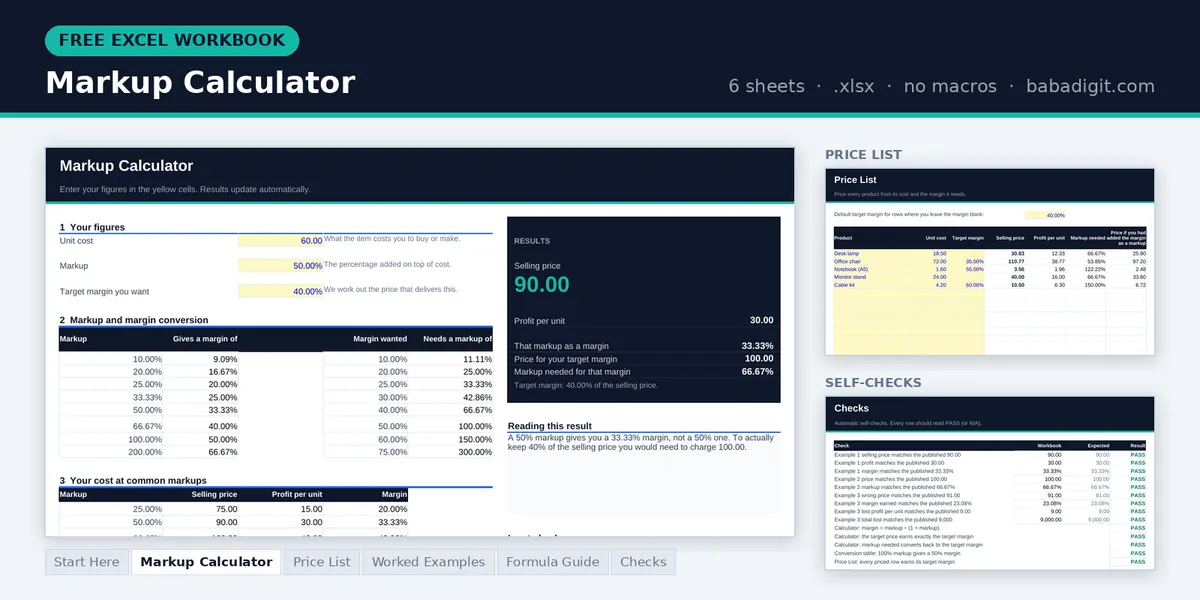
- Markup Calculator — selling price, profit, the markup as a margin and the price for your target margin
- Conversion tables — markup to margin and margin to markup for common percentages
- Price List — price up to 25 products from cost and target margin
- Worked examples, formula guide and checks — including what confusing markup and margin costs
Opens in Microsoft Excel or LibreOffice Calc. General information only, not financial advice.
Once prices are set, the next question is volume. The Sales Forecast Template is a paid spreadsheet that forecasts twelve months of sales by product line, with growth, seasonality and forecast-vs-actual tracking. Browse all templates
Markup and margin are not the same thing
This is the most expensive misunderstanding in small business pricing, and it costs money quietly, every single sale, for years.
Markup is measured against what the item cost you. Margin is measured against what you sold it for. Same profit, different denominator, very different percentage. An item costing $60 sold at $90 carries a 50% markup and a 33.33% margin — both describe the same $30. To work from the selling price instead, use the gross margin calculator for gross profit margin, or the profit margin calculator for operating and net margin.
The damage happens when the two get mixed. An owner decides the business needs a 40% margin to cover overheads, then instructs staff to add 40% to cost. Every item now carries a 28.6% margin instead. On $500,000 of sales that is roughly $57,000 of gross profit that was budgeted for and never arrives — usually discovered at year end, when it is far too late to reprice.
The formulas
Selling price = Cost × (1 + Markup)Margin = Markup ÷ (1 + Markup)Markup = Margin ÷ (1 − Margin)Price for a target margin = Cost ÷ (1 − Target margin)That last line is the one to commit to memory. To hit a 40% margin, divide the cost by 0.60 — never multiply by 1.40. Dividing by one minus the margin is how you price when you know what you need to keep.
Three worked examples
The basic conversion
A 50% markup
An item costs $60. You add 50%.
Profit = 90 − 60 = 30.00
Markup = 30 ÷ 60 = 50.00% (against cost)
Margin = 30 ÷ 90 = 33.33% (against price)
One transaction, one $30 profit, two correct percentages. Neither is wrong — but quoting the wrong one to your accountant, your bank or yourself leads to decisions built on a number that is 17 points too optimistic.
Pricing backwards
Starting from the margin you need
The same $60 item, but you have worked out that the business needs a 40% gross margin to cover its overheads.
Profit = 40.00, which is 40% of 100 ✓
Expressed as a markup, that is 40 ÷ 60 = 66.67%
To keep 40% of the price you have to add 66.67% to the cost. This is why margin targets always translate into markup figures that feel uncomfortably high — and why businesses that price by instinct usually undercharge.
The costly error
What confusing them actually costs
A shop wants a 30% margin on an item costing $70. Staff are told to “add 30%”.
What was needed: 70 ÷ 0.70 = 100.00 → margin = 30 ÷ 100 = 30.00%
Lost profit = 9.00 per unit
Across 1,000 units = 9,000 of gross profit, gone
Nearly a third of the intended profit disappears, and nothing in the accounts flags it. Sales look fine, the shop looks busy, and the gross margin line quietly reads seven points below budget.
Conversion table
| If your markup is | Your margin is | Markup needed for a margin of that % |
|---|---|---|
| 10% | 9.09% | 11.11% |
| 20% | 16.67% | 25.00% |
| 25% | 20.00% | 33.33% |
| 50% | 33.33% | 100.00% |
| 100% | 50.00% | — |
| 200% | 66.67% | — |
Read the first two columns together: whatever markup you apply, the margin is always smaller. The third column reads the other way — the markup needed to earn the column-one percentage as a margin. Note that a 50% margin requires a 100% markup, which is why “keystone” pricing in retail means doubling the cost.
Where markup thinking goes wrong
How to calculate markup in Excel or Google Sheets
Cost in B1, markup as a decimal in B2, target margin as a decimal in B3:
=B1*(1+B2) ← price from a markup=B2/(1+B2) ← that markup as a margin=B1/(1-B3) ← price for a target marginBuild these three into your price list once and the confusion cannot recur. Label the columns “markup” and “margin” explicitly — a column headed just “%” is how the error gets in.
Frequently asked questions
What is the difference between markup and margin?
Markup is profit as a percentage of cost; margin is the same profit as a percentage of the selling price. Because the selling price is always larger than the cost, the margin is always the smaller number. A 50% markup equals a 33.3% margin.
How do I convert a margin into a markup?
Divide the margin by one minus the margin. A 40% margin becomes 0.40 ÷ 0.60 = 66.67% markup. Going the other way, divide the markup by one plus the markup: a 60% markup is 0.60 ÷ 1.60 = 37.5% margin.
Which should I use for pricing?
Set prices from the margin you need, because margin is what appears in your accounts and what has to cover your overheads. Use markup only as the arithmetic shortcut to get there. Deciding in margin and executing in markup is where businesses go wrong.
Can markup be more than 100%?
Easily. A 200% markup means selling at three times cost, which gives a 66.7% margin — normal in jewellery, cosmetics and hospitality drinks. Margin, by contrast, can never reach 100%, because that would mean the item cost you nothing.
What is keystone pricing?
Retail shorthand for doubling the cost — a 100% markup, which is exactly a 50% margin. It survives because it is easy to do in your head and lands on a round margin, not because 50% is right for every product.
Should markup cover overheads too?
Yes, it has to. Markup is applied to direct cost, but the gross profit it produces must cover rent, wages, marketing and everything else before anything is left. Work out your overheads as a percentage of expected sales first; that tells you the minimum margin, and therefore the minimum markup.
References
- Horngren, C. T., Datar, S. M. & Rajan, M. V. Cost Accounting: A Managerial Emphasis, 16th edition, Pearson — on cost-plus pricing and target margins.
- Nagle, T. T. & Müller, G. The Strategy and Tactics of Pricing, 6th edition, Routledge — on the limits of cost-based pricing.
Keep going
Written and reviewed by Ghayas Uddin, MS (Finance), financial analyst. Last reviewed 21 September 2026. Found an error? Email support@babadigit.com and we will correct it.