
Reading this result: 15% of 240.00 is 36.00.
General information only. Check any figure before you act on it.
Free percentage calculator Excel workbook
The same method as the calculator above, in a spreadsheet you can keep, edit and share — with all three calculators side by side, a reverse-percentage tool and a change table for up to 24 periods.
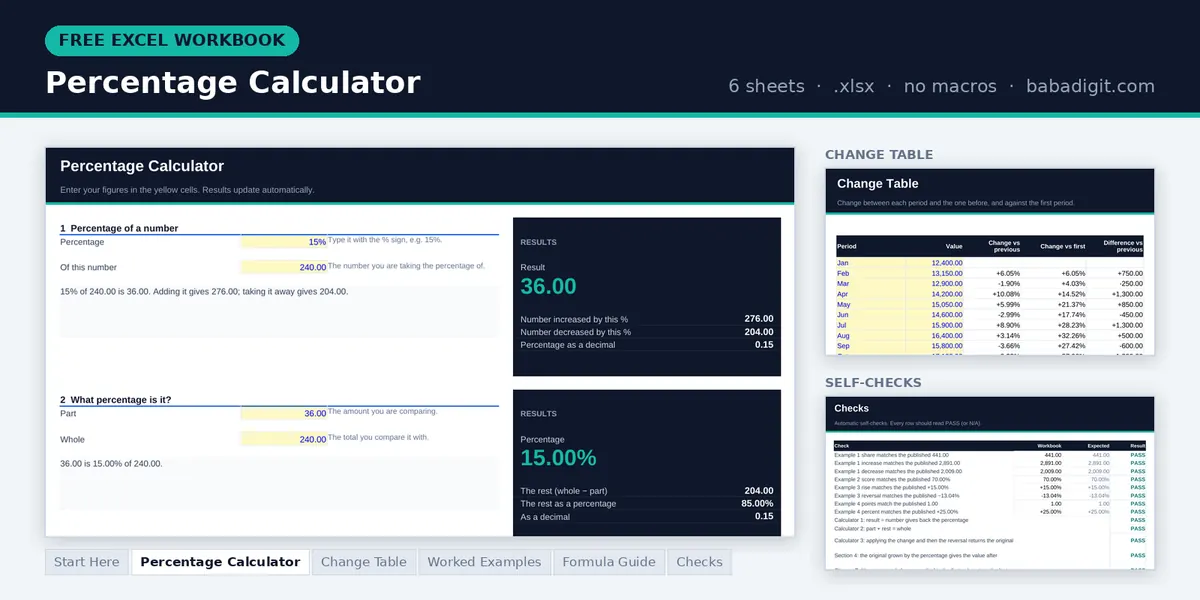
- Percentage Calculator — % of a number, what % one number is of another and % change, plus reversing an increase and percent vs percentage points
- Change Table — change vs the previous period and vs the first, with the simple and compound average change
- Worked examples — the four examples from this page, rebuilt
- Formula guide and checks — the maths in plain English, plus built-in self-tests
Opens in Microsoft Excel or LibreOffice Calc. General information only.
Tracking the same percentages every month? The KPI Dashboard Template is a paid spreadsheet for following your key business figures over time. Browse all templates
Three percentage questions
A percentage is a number out of 100. Almost every everyday percentage problem is one of three questions: what is a given percentage of a number, what percentage one number is of another, and by what percentage a figure has changed. Choose the matching tab above and the calculator works it out.
The first tab also shows the number increased and decreased by the percentage, which is what you need for a price rise, a pay rise, a tip or a simple discount. The third tab shows the change needed to get back to where you started — usually not the same percentage, for reasons explained below.
The percentage formulas
Percentage of a number: Result = P ÷ 100 × NumberWhat percentage: P = Part ÷ Whole × 100Percentage change: P = (New − Old) ÷ |Old| × 100The vertical bars around Old mean its size without the sign. When the starting value is positive, which is almost always, they make no difference. They only matter when you start from a negative number, such as a loss turning into a smaller loss.
Four worked examples
Percentage of a number
Working out a share
A business sets aside 18% of a 2,450 payment for tax.
2,450 + 441 = 2,891.00
2,450 − 441 = 2,009.00
441.00 goes aside. The same 18% added to 2,450 gives 2,891.00, and taken off gives 2,009.00.
What percentage
Scoring a test
A student scores 42 marks out of 60.
0.70 × 100 = 70.00%
The score is 70.00%. The 18 marks dropped are the other 30.00%.
Percentage change
A price rise and its reversal
A product’s price goes from 80 to 92, then a promotion takes it back to 80.
Down: (80 − 92) ÷ 92 × 100 = −13.04%
The rise is 15.00%, but the cut that reverses it is only 13.04%, because it is taken from the higher price.
Percentage points
When a rate changes
An interest rate moves from 4% to 5%.
Change: (5 − 4) ÷ 4 × 100 = +25.00%
Both statements are true. “Up one point” and “up 25%” describe the same move, which is why it matters which one a headline uses.
Why percentage changes don’t cancel out
A percentage is always taken from a starting figure, and after a change the starting figure is different. A rise of 50% followed by a fall of 50% does not bring you back: 100 becomes 150, and 150 less 50% is 75. To undo a 50% rise you need a fall of 33.33%; to undo a 50% fall you need a rise of 100%.
The same trap catches people who try to remove a percentage that has already been added. If a price of 115 includes a 15% increase, the original was 115 ÷ 1.15 = 100, not 115 less 15%. Divide by one plus the percentage. The VAT Calculator applies exactly this method to take VAT out of a total.
| A rise of | is undone by a fall of | A fall of | is undone by a rise of |
|---|---|---|---|
| 10% | 9.09% | 10% | 11.11% |
| 20% | 16.67% | 20% | 25.00% |
| 25% | 20.00% | 25% | 33.33% |
| 50% | 33.33% | 50% | 100.00% |
| 100% | 50.00% | — | — |
A fall of 100% takes a positive value to zero, and no percentage rise brings it back.
Percent or percentage points?
When the thing being measured is itself a percentage — an interest rate, a tax rate, a margin, an unemployment rate — there are two ways to describe a change. The difference between the two rates is in percentage points. The change relative to the starting rate is in percent. A margin that slips from 20% to 18% has fallen by 2 percentage points, which is a 10% fall in the margin.
Use percentage points when you compare rates, and say which you mean. “The rate is up 50%” sounds dramatic; “up from 2% to 3%” tells the reader what actually happened.
Do it in a spreadsheet
With the first number in A1 and the second in B1:
- A1% of B1:
=A1/100*B1 - A1 as a percentage of B1:
=A1/B1, formatted as a percentage. - Change from A1 to B1:
=(B1-A1)/ABS(A1), formatted as a percentage. - B1 increased by A1%:
=B1*(1+A1/100)
If you type 15% into a cell rather than 15, the spreadsheet stores it as 0.15 — drop the “/100” from the formulas above in that case.
Frequently asked questions
How do I calculate a percentage of a number?
Divide the percentage by 100 and multiply by the number. 18% of 2,450 is 18 ÷ 100 × 2,450 = 441. On a calculator, 2,450 × 0.18 gives the same answer.
How do I work out what percentage one number is of another?
Divide the part by the whole and multiply by 100. A score of 42 out of 60 is 42 ÷ 60 × 100 = 70%.
How do I calculate a percentage increase or decrease?
Subtract the old value from the new one, divide by the old value and multiply by 100. A price that goes from 80 to 92 has risen by (92 − 80) ÷ 80 × 100 = 15%. A negative answer is a decrease.
Why doesn’t a 50% fall undo a 50% rise?
Because each percentage is taken from a different starting figure. 100 rising by 50% becomes 150; 150 falling by 50% becomes 75, not 100. To get back to 100 from 150 you need a fall of 33.33%.
What is the difference between percent and percentage points?
Percentage points measure the gap between two percentages; percent measures the change relative to where you started. A rate that moves from 4% to 5% has risen by 1 percentage point, which is a 25% increase in the rate.
How do I find the original number before a percentage increase?
Divide by one plus the percentage as a decimal, rather than subtracting the percentage. A price of 115 after a 15% rise was 115 ÷ 1.15 = 100 before it. Taking 15% off 115 gives 97.75, which is wrong. The VAT Calculator uses the same method to take VAT out of a total.
Can a percentage be more than 100%?
Yes. A part can be more than 100% of a whole when it is larger than the whole, and a value can grow by more than 100%: going from 40 to 100 is a 150% increase. A decrease, though, cannot be more than 100% for a positive starting value — 100% means falling to zero.
Keep going
Written and reviewed by Ghayas Uddin, MS (Finance), financial analyst. Last reviewed 4 October 2026. Found an error? Email support@babadigit.com and we will correct it.